Steels
Steel is the variable people obsess over and the one that explains the least about how a knife cuts. Geometry decides how a blade moves through food. Heat treatment decides whether the steel actually delivers what its datasheet promises. Steel choice sets the ceiling for edge retention, toughness, corrosion resistance, and how the knife behaves on stones, but a well ground and well hardened Shirogami 2 gyuto will out-cut a badly executed powder steel every time. Read this section as a guide to what a steel can do, not as a ranking.
What the numbers mean
Carbon (C). The element that makes hardening possible. More carbon means more hardness available and, past roughly 0.6 percent, more carbide formation. Above what the matrix can dissolve, extra carbon goes into carbides rather than raw hardness.
Carbides. Hard particles of carbon bonded to chromium, vanadium, tungsten, or molybdenum, sitting in a softer steel matrix. Carbides resist abrasion, so they buy edge retention. They are also brittle, and a carbide larger than the apex of your edge is a place where the edge can tear out. This is the central trade-off in knife steel: carbide volume buys wear resistance, carbide size costs toughness and fine-edge stability.
Chromium (Cr). Above roughly 10.5 percent dissolved in the matrix, chromium forms a passive oxide film and the steel is called stainless. The word "dissolved" matters. Chromium locked into chromium carbides is not available to fight corrosion, which is why total chromium percentage alone does not predict rust resistance. MagnaCut is the clearest illustration: under 11 percent chromium, but almost all of it free, so it out-resists steels with much higher totals.
Vanadium (V), tungsten (W), molybdenum (Mo). Strong carbide formers. Vanadium carbides are the hardest of the common ones, which is why high-vanadium steels hold an edge a long time and fight back on anything but diamond or silicon carbide stones. Tungsten is the traditional Japanese route to wear resistance and gives the Blue steels their character. Molybdenum improves hardenability and corrosion resistance.
Cobalt (Co). Does not form carbides. It strengthens the matrix and allows higher hardness at temper, mostly relevant in high-speed steels.
HRC. Rockwell C hardness. Most Japanese kitchen knives land between 60 and 64. Harder generally means better edge retention and a crisper edge, at the cost of chip resistance. HRC is set by heat treatment, not by the steel alone, and the same alloy from two smiths can behave very differently. Published HRC figures from makers are also not independently verified, so treat them as intent rather than measurement.
Ingot versus powder (PM). Conventional ingot steel solidifies slowly, so carbides grow large and can segregate. Powder metallurgy atomizes the molten alloy, then consolidates the powder under heat and pressure, giving small evenly distributed carbides. PM is what makes very high alloy content usable in a thin kitchen edge. It costs more, and it does not make a steel automatically better than a fine-grained ingot steel like Shirogami or AEB-L.
Purity. The Yasugi carbon steels are prized less for their alloy content, which is minimal, than for very low phosphorus and sulfur. Inclusions are crack initiation sites. Low impurity is a large part of why White steel takes such a clean edge.
Construction: monosteel, san mai, honyaki
Most Japanese knives are not made of one steel. A hard core is forge-welded between two softer outer layers, called san mai or awase. The core provides the edge, the cladding provides toughness and cost savings, and the visible difference between the two produces the kasumi (misty) finish on traditional knives. Cladding is usually soft iron (jigane) on carbon knives, or a low-carbon stainless such as SUS410 or SUS430 on stainless-clad knives.
A stainless-clad carbon knife is still a carbon knife. The exposed edge and the whole bevel are reactive. It is less maintenance than a full carbon blade, not no maintenance.
Monosteel blades are a single steel throughout. Honyaki is monosteel differentially hardened, water quenched with a clay coating so the edge is hard and the spine is soft. Honyaki is difficult, has a high failure rate in the shop, and is priced accordingly. Whether it cuts measurably better than a good kasumi knife is disputed. Most of the argument for it is about craft and edge stability at very high hardness rather than a difference you would feel in prep.
Japanese carbon steels (Yasugi Specialty Steel)
The core carbon steels come from the Yasugi works in Shimane prefecture, run by Hitachi Metals until the company was renamed Proterial in 2023. Grades are named for the color of the paper wrapped around the steel bar, not the appearance of the finished blade. All of them rust. All of them will develop a patina, which is stable oxide and is mildly protective.
| Steel | Also called | C | Cr | W | Mo | V | Typical HRC |
|---|---|---|---|---|---|---|---|
| Shirogami 1 | White 1, Shiroichi | 1.25 to 1.35 | - | - | - | - | 61 to 64 |
| Shirogami 2 | White 2, Shironi | 1.05 to 1.15 | - | - | - | - | 60 to 63 |
| Shirogami 3 | White 3 | 0.80 to 0.90 | - | - | - | - | 58 to 61 |
| Aogami 1 | Blue 1, Aoichi | 1.25 to 1.35 | 0.20 to 0.50 | 1.50 to 2.00 | - | - | 61 to 64 |
| Aogami 2 | Blue 2, Aoni | 1.05 to 1.15 | 0.20 to 0.50 | 1.00 to 1.50 | - | - | 60 to 63 |
| Aogami Super | Blue Super, AS | 1.40 to 1.50 | 0.30 to 0.50 | 2.00 to 2.50 | 0.30 to 0.50 | 0.30 to 0.50 | 62 to 65 |
| Kigami 2 | Yellow 2 | ~1.0 to 1.1 | - | - | - | - | 58 to 62 |
| SK85 / SK95 | SK4, SK5 (old names) | 0.80 to 1.00 | trace | - | - | - | 58 to 61 |
All Yasugi grades also carry roughly 0.10 to 0.20 percent silicon and 0.20 to 0.30 percent manganese, with phosphorus held at or below 0.025 percent and sulfur at or below 0.004 percent.
Shirogami 2 (White 2). The default traditional carbon steel and the most common in single-bevel knives. Plain iron and carbon with almost nothing else, held to very tight impurity limits. It sharpens faster and more cleanly than anything alloyed, gives immediate feedback on a stone, and takes an extremely fine apex. It gives that edge back faster too. It is reactive, has a shallow hardening depth that demands a fast quench, and rewards a smith who knows what they are doing. If you sharpen weekly and enjoy it, this is the steel.
Shirogami 1 (White 1). Same recipe, more carbon. Slightly harder, slightly better retention, noticeably less forgiving. Common in honyaki and in high-end yanagiba where the maker is chasing the finest possible edge. Chips more readily than White 2 and is less tolerant of heat treatment error, which is why White 2 remains the working chef's choice.
Shirogami 3 (White 3). Lower carbon, tougher, softer, easier for a beginner to sharpen and harder to chip. Sees use in entry knives and in some nakiri and deba. Edge retention is modest. Not common in premium work.
Aogami 2 (Blue 2). White 2 with tungsten and a little chromium added. The tungsten forms carbides that meaningfully extend edge life, at the cost of a slightly less refined apex and a slower, grabbier feel on stones. Chromium improves hardenability, which gives the smith a wider window and makes the steel more forgiving to forge. The most common carbon steel on double-bevel Japanese knives and a reasonable default if you want carbon steel without weekly maintenance.
Aogami 1 (Blue 1). More carbon than Blue 2, more tungsten. Harder, holds longer, chips more. Less common than Blue 2 or Aogami Super, occupying a narrow band between them. Some smiths prefer it for its balance; opinions differ on whether it earns a place next to its neighbors.
Aogami Super. The high end of the Yasugi carbon line: more carbon and tungsten than Blue 1, plus molybdenum and vanadium. It runs 63 to 65 HRC comfortably and has by a clear margin the best edge retention of the traditional carbon steels. The vanadium and tungsten carbides make it slower on natural stones and on soft synthetics, and it is less tolerant of lateral force than Blue 2. Widely used by Takeda, Moritaka, Yoshikane, Kurosaki, and others.
Kigami 2 (Yellow 2). Effectively White steel with looser impurity limits and a lower price. Perfectly usable, and common in inexpensive Tosa and Sanjo work. It will not reach the fineness of White 2 but the practical gap is smaller than the price gap.
SK steel. Japanese industrial carbon steel (SK stands for steel and kougu, meaning tool). Now graded by carbon content as SK85, SK95 and so on, formerly SK4 and SK5. Cheap, tough, easy to sharpen, modest retention. Common in budget knives and in cladding.
Japanese stainless steels
| Steel | Maker | Process | C | Cr | Mo | V | Co | Typical HRC |
|---|---|---|---|---|---|---|---|---|
| Ginsan (Gin3) | Proterial | Ingot | 0.95 to 1.10 | 13.0 to 14.5 | - | - | - | 59 to 62 |
| VG-10 | Takefu | Ingot | ~1.0 | 15 | 1.0 | 0.2 | 1.5 | 60 to 62 |
| VG-1 | Takefu | Ingot | ~1.0 | 13 to 15 | 0.2 to 0.4 | - | - | 58 to 60 |
| VG-5 | Takefu | Ingot | 0.70 to 0.80 | 13 to 15 | 0.2 to 0.4 | 0.1 to 0.2 | - | 58 to 60 |
| AUS-8 | Aichi | Ingot | ~0.75 | 13 to 14.5 | 0.1 to 0.3 | 0.1 to 0.25 | - | 57 to 59 |
| AUS-10 | Aichi | Ingot | ~1.05 | 14 | 0.2 | 0.2 | - | 58 to 61 |
| ZA-18 | Aichi | Ingot | 0.95 to 1.20 | 17 to 18 | 1.0 to 1.5 | 0.1 to 0.25 | - | 61 to 63 |
| SG2 / R2 | Takefu / Kobelco | PM | 1.25 to 1.45 | 14 to 16 | 2.3 to 3.3 | 1.8 to 2.2 | - | 62 to 64 |
| SRS13 | Nachi-Fujikoshi | PM | ~1.3 (reported) | ~13 (reported) | ~2.75 (reported) | ~1.5 (reported) | - | 62 to 64 |
| SRS15 | Nachi-Fujikoshi | PM | ~1.5 (reported) | ~13 (reported) | ~2.75 (reported) | ~1.5 (reported) | - | 63 to 65 |
| ZDP-189 | Proterial | PM | ~3.0 | ~20 | ~1.4 | ~0.1 | - | 64 to 67 |
| Cobalt Special | Takefu | Remelt | ~1.1 | ~16 | ~1.5 (reported) | ~0.3 (reported) | ~2.5 (reported) | 60 to 62 |
SRS13 and SRS15 also carry roughly 1.25 percent tungsten, 0.30 percent manganese, and 0.30 percent silicon (reported). Cobalt Special carries roughly 0.3 percent tungsten (reported). The SRS and Cobalt Special figures come from retailer and enthusiast databases rather than mill datasheets, but the same numbers recur across independent sources, so they are usable with the caveat.
Ginsan (Silver 3). The stainless that behaves like carbon steel. Around 1 percent carbon and 13 to 14.5 percent chromium, with no molybdenum, vanadium, or cobalt, so it forms only chromium carbides and stays fine-grained. On a stone it gives clean, fast feedback and forms a burr that comes off easily, which is why Sakai shops reach for it when a customer wants White 2 handling without the rust. Edge retention is modest by modern standards, roughly comparable to White 2. Common in single-bevel stainless work.
VG-10. The most widely produced Japanese cutlery stainless, from Takefu. Chromium at 15 percent with molybdenum, vanadium, and cobalt added. Good corrosion resistance, decent retention, runs 60 to 62 HRC. It has a reputation among sharpeners for forming a stubborn wire edge and feeling gummy on stones, which is the most frequent complaint about it. Very often used as the core of Damascus-clad production knives from Seki.
AUS-8 and AUS-10 (Aichi). AUS-8 is a modest, forgiving stainless used widely in mid-price knives, often marketed under names like "Inox" or "molybdenum stainless." AUS-10 has roughly the carbon of VG-10 with less chromium, so slightly better retention and slightly less corrosion resistance. Both sharpen easily and neither will impress on edge life.
ZA-18. Aichi's answer to VG-10, with more chromium and molybdenum and no cobalt. Retailers report better edge retention and comparable corrosion resistance, and it runs a bit harder at 61 to 63. Community experience with it is thinner than with VG-10 simply because it is newer, so treat performance claims as commonly reported rather than settled.
SG2 and R2. The standard premium powder stainless. SG2 comes from Takefu, R2 from Kobelco, and the two are close enough in composition and behavior that the trade treats them as interchangeable; whether they are literally the same steel is a common claim but not something the mills confirm. Vanadium and molybdenum carbides in a fine PM structure give strong edge retention at 62 to 64 HRC with genuinely good corrosion resistance. The trade-off is chipping: ground thin, at that hardness, SG2 edges chip on hard contact and the carbides make touch-ups slower than Ginsan or White 2. Diamond or silicon carbide stones help.
SRS13 and SRS15 (Nachi-Fujikoshi). Powder stainless in the same performance class as SG2. Composition is reported as roughly 13 percent chromium, 2.75 molybdenum, 1.5 vanadium, and 1.25 tungsten, with SRS15 at about 1.5 percent carbon and SRS13 at about 1.3. Structurally that is close to a powder D2 with extra molybdenum, vanadium, and tungsten added. SRS15 is the older grade and is reportedly restricted to a small set of licensed makers, with SRS13 developed as the more widely available modification (reported, not confirmed by the mill). Both run 63 to 64 HRC and sharpen more easily than the alloy content suggests. Takeshi Saji is the best-known SRS13 user; Haruyuki-Tsunehisa, formerly Akifusa, is the name attached to SRS15.
ZDP-189. Proterial's extreme powder stainless: roughly 3 percent carbon and 20 percent chromium, hardened to 64 to 67 HRC. Enormous edge retention, and correspondingly hard to sharpen (diamonds are effectively required) and brittle in thin geometry. Also sold as MC66 in some Zwilling knives. Its huge chromium carbide volume means much less free chromium than 20 percent suggests, so it is less rust resistant than the number implies.
Cobalt Special (Takefu). About 1.1 percent carbon and 16 percent chromium, with roughly 1.5 molybdenum, 0.3 vanadium, 0.3 tungsten, and 2.5 cobalt (reported). Worth noting that this is not a powder steel, despite being sold as one by a number of retailers: Takefu describes it as made by a special remelting process that produces uniform composition and fine carbide dispersion. Marketed primarily on corrosion resistance, at 60 to 62 HRC. Seen mostly in Sakai Takayuki lines.
Japanese semi-stainless and high-speed steels
These carry 4 to 13 percent chromium: too much to be called carbon steel, too little free chromium to be reliably stainless. They rust more slowly than White or Blue and still need drying.
| Steel | Also called | C | Cr | Mo | W | V | Co | Typical HRC |
|---|---|---|---|---|---|---|---|---|
| SLD | SKD11, D2 class | ~1.5 | ~12 | ~0.9 | - | ~0.3 | - | 61 to 63 |
| VS1 | Chromax, SKD12, A2 class | 0.95 to 1.05 | 4.5 to 5.5 | 0.8 to 1.2 | - | ~0.2 | - | 61 to 63 |
| HAP40 | Proterial PM HSS | 1.27 to 1.37 | 3.7 to 4.7 | 4.6 to 5.4 | 5.6 to 6.4 | 2.8 to 3.3 | 7.5 to 8.5 | 63 to 66 |
| HAP72 | Proterial PM HSS | ~2.15 | ~4.2 | ~8.25 | ~9.5 | ~5.0 | ~9.5 | 66+ |
SLD. Hitachi's D2-equivalent, originally a tool steel for cutting other steels. High chromium carbide volume gives long edge life and a toothy, aggressive edge that never gets truly refined. Not stainless despite 12 percent chromium, because nearly all of it is tied up in carbides. SLD-Magic is a modified version claimed to improve toughness and grain refinement; the claims come from the maker.
VS1 (Chromax, SKD12). An A2-class semi-stainless. Far lower chromium than SLD, so smaller and fewer carbides, a finer edge, and better toughness at similar hardness. Sharpens more like a carbon steel than SLD does. A quiet favorite among people who want most of carbon steel's feel with a lot less rust anxiety.
HAP40. Powder high-speed steel from Proterial, functionally equivalent to Crucible's Rex 45 and Erasteel's ASP2030. Cobalt lets it run 63 to 66 HRC, and the tungsten, molybdenum, and vanadium carbides give edge retention at the top of anything used in kitchen knives. It will stain and can rust, so it is semi-stainless at best. Sharpening is genuinely difficult without diamond or silicon carbide abrasives. HAP72 is the same idea taken further and is rare.
Western steels used in Japanese-style knives
An increasing number of Japanese makers, and most Western makers of Japanese-style knives, work in these.
| Steel | Origin | Process | Stainless | C | Cr | Other | Typical HRC |
|---|---|---|---|---|---|---|---|
| AEB-L / 13C26 | Uddeholm / Sandvik | Ingot | Yes | 0.68 | 12.9 | - | 60 to 63 |
| 14C28N | Sandvik | Ingot | Yes | 0.62 | 14 | N 0.11 | 59 to 62 |
| Nitro-V | New Jersey Steel Baron | Ingot | Yes | 0.68 | 13 | V 0.08, N 0.11 | 60 to 62 |
| CPM MagnaCut | Crucible | PM | Yes | 1.15 | 10.7 | Mo 2, V 4, Nb 2, N 0.2 | 61 to 64 |
| CPM-154 / ATS-34 | Crucible / Hitachi | PM / ingot | Yes | 1.05 | 14 | Mo 4 | 60 to 62 |
| X50CrMoV15 | Germany | Ingot | Yes | 0.5 | 15 | Mo 0.65, V 0.2 | 55 to 58 |
| 52100 | US / EU | Ingot | No | ~1.0 | 1.5 | - | 61 to 64 |
| 1.2519 | Germany | Ingot | No | 1.1 | 1.2 | W 1.3, V 0.2 | 62 to 64 |
| 26C3 | Sweden | Ingot | No | 1.25 | 0.3 | - | 62 to 65 |
| Apex Ultra | Netherlands / Germany | Ingot | No | 1.25 | 1.5 | W 2.6, V 0.4 | 63 to 66 |
AEB-L. Originally a Swedish razor blade stainless, and the reason it matters here is grain size. Low carbon relative to its chromium means very few carbides, so it takes an apex about as fine as a carbon steel while being fully stainless. Excellent toughness for a stainless at 61 to 62 HRC, easy to sharpen on any stone, cheap. Edge retention is modest against high-carbide steels but the edge that it does hold is a very good one. 13C26 is essentially the same alloy; 14C28N and Nitro-V are nitrogen-modified relatives with slightly better corrosion resistance.
CPM MagnaCut. Designed by Larrin Thomas and released by Crucible in 2021, explicitly for knives. The trick is balancing chromium and carbon so that vanadium and niobium take the carbon into their own carbides, leaving chromium free in the matrix. Result: corrosion resistance above most high-chromium stainless steels, with toughness and wear resistance in the class of CruWear and 4V. It is the most credible current answer to the stainless-versus-performance trade-off and has been adopted quickly by Western kitchen makers. Sharpening needs diamond or silicon carbide at higher grits because of the vanadium carbides.
52100. A chromium bearing steel, not stainless, around 1 percent carbon with 1.5 percent chromium. Fine grained, tough, takes a keen edge, and forgiving to forge, which is why so many Western smiths use it. Its reputation varies enormously with the maker: the same alloy produces mediocre and outstanding knives depending on heat treatment. Reactive, so treat it like a carbon steel.
Apex Ultra. A carbon steel developed specifically for handmade knives, alloyed with tungsten and vanadium and made to very high purity. The maker's claim is the best toughness of any knife steel tested above 66 HRC, along with strong edge retention, with forging behavior similar to 52100. It is a young steel and the independent data is still thin, so treat performance claims as maker-reported. Adoption among Western kitchen smiths has been fast.
1.2519 and 26C3. German and Swedish carbon steels that have found a home in Japanese-style knives. 1.2519 is close in spirit to Blue steel, with tungsten for wear resistance. 26C3 is a very clean, very simple high-carbon steel that behaves much like White 1 and hardens deeply.
X50CrMoV15 and 1.4116. The German production stainless steels, around 0.5 percent carbon, run soft at 55 to 58 HRC. Corrosion resistant, tough, easy to sharpen, and unable to hold a fine edge for long. This is what most European factory knives are made of. Not a Japanese-style steel, included because it is the baseline most people are comparing against.
Tamahagane
Tamahagane is steel smelted in a traditional clay tatara furnace from iron sand, rather than produced in a modern mill. It is the historical material of Japanese swords, and it survives in kitchen cutlery only as a specialty: composition is inconsistent by nature, the smelt is labour-intensive, and the smith has to sort usable pieces by eye. Knives made from it are bought for provenance and craft rather than measurable performance.
Tanabe Tatara is the operation most often behind tamahagane kitchen knives. The Tabe family traces steelmaking to 1460, and the 25th-generation Tabe Chouemon restarted tatara smelting in 2016. They run two smelts a year and supply the steel to established smiths rather than forging knives themselves; one documented example is a blade forged by Yoshikazu Tanaka and ground by Masaya Shimizu in Sakai. Because knives are usually marketed under the Tanabe name, buyers reasonably but wrongly assume it is a forge.
Choosing
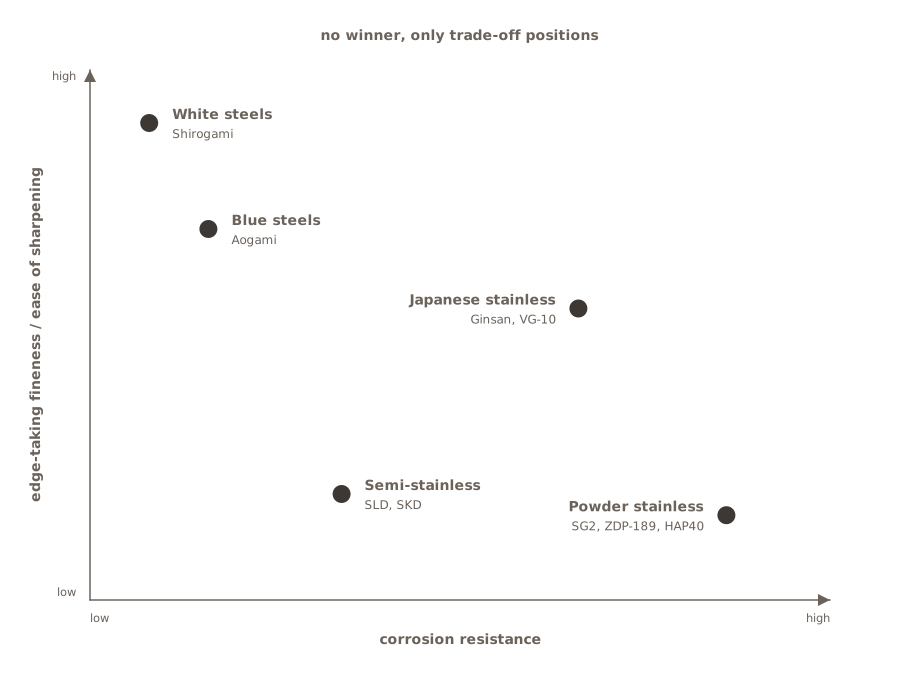
There is no best steel, only a set of positions on the same three-way trade-off between edge retention, toughness, and corrosion resistance. A few honest starting points:
- Learning to sharpen, want carbon: Shirogami 2 or Aogami 2.
- Learning to sharpen, want stainless: Ginsan or AEB-L.
- Least maintenance with good performance: MagnaCut, SG2, or Ginsan.
- Maximum edge life, willing to buy diamond stones: HAP40, ZDP-189, or SG2.
- Maximum edge fineness, willing to maintain it: Shirogami 1 or 2, or a good 26C3.
The consistent argument from experienced users, and one worth taking seriously, is that on a home kitchen board the difference between a well-executed AEB-L or White 2 knife and a super steel knife shows up mostly on the sharpening bench rather than in the food. Buy the maker and the grind first.
Sources
Proterial (Yasugi Specialty Steel) grade listings for the Shirogami, Aogami, and Gin families; Takefu Special Steel product information; Aichi Steel product information; Knife Steel Nerds (Larrin Thomas) for MagnaCut, carbide theory, and steel property testing; zknives steel database for SRS13, SRS15, and HAP-series information; Takefu's Cobalt Special product page; Knifewear, Seisuke, The Cook's Edge, Japanese Chefs Knife Co., Chef Knives To Go, Japan-Knives, Okami Blades, and Hasu-Seizo retailer specification pages; the project reference document.