Construction and Finishes
Two different things get talked about as if they were one. Construction is how the blade is put together: one piece of steel, or a hard core wrapped in something softer. It affects performance, maintenance, and price. Finish is what was done to the outside surface afterwards. It is mostly cosmetic, with small effects on food release and rust.
Retailers mix the two constantly. A listing that says "kurouchi san mai aogami 2" is telling you the finish, the construction, and the core steel, in that order, but plenty of listings only give you one of the three.
Construction
How a clad knife works
Most Japanese kitchen knives are laminated: a hard, high carbon core steel (hagane) is forge welded inside softer outer layers (jigane, traditionally soft iron). Only the core reaches the edge. Everything else is structure.
The reasons are practical and old. Hard steel at 61 to 64 HRC holds an edge but is brittle and expensive. Soft cladding absorbs impact and flex, so the blade can be ground very thin without shattering, and it uses less of the costly core steel. It also grinds and sharpens faster, which matters when you eventually thin the knife behind the edge.
The practical consequences for you:
- The core steel determines cutting performance and edge retention. The cladding does not. If a knife lists a Blue #2 core, that is the steel doing the work regardless of how pretty the outside is.
- The cladding determines maintenance. A carbon core in stainless cladding only rusts at the edge. A carbon core in iron cladding will patina and react across the whole blade face.
- Cladding affects sharpening and thinning. Soft iron abrades quickly and polishes nicely on natural stones. Stainless cladding is stiffer, gummier on stones, and harder to bring to a clean finish.
- Construction type matters less than most people expect. Between san mai and warikomi, at the same steel and geometry, the difference is negligible. Honyaki versus clad is a real difference, but more in behavior and price than in raw cutting.
One warning about terminology. Kasumi strictly means "mist" and describes a polish, the hazy soft cladding sitting next to the brighter core. Japanese wholesalers also use "kasumi" and "hon-kasumi" as product grades for laminated single bevel knives, so the word gets used to mean construction, finish, and quality tier depending on who is talking. Read it from context, and expect disagreement in the community about which use is correct.
Construction types
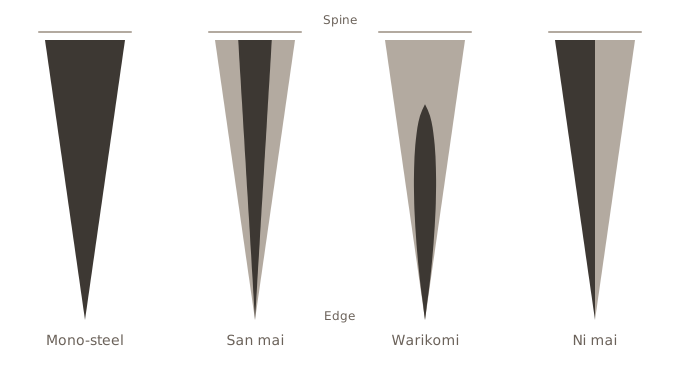
Honyaki A single bar of steel, no cladding, differentially hardened so the edge is hard and the spine stays softer and more shock absorbent. Clay is applied before quenching, leaving a visible transition line (hamon) after polishing. Water quenched (mizu honyaki) is the harder version to execute; oil quenched (abura honyaki) is more forgiving. Failure rates in forging are high and few smiths make them in volume, which is most of the reason for the price. Honyaki are stiff, hold an edge well, and are unforgiving: no soft cladding to absorb a bad lateral hit, and the whole blade is reactive if it is carbon. Western usage often calls any mono-steel blade honyaki, which is not what the term means.
Mono-steel (non-honyaki) One piece of steel with no cladding and no differential hardening. Common in machine-made stainless knives and in some rustic carbon knives. Tough and simple, usually run at lower hardness, so expect to sharpen more often but worry less about chipping. Sometimes called zenko, though the term is rarely seen on Western listings.
San mai Three layers: a full sheet of core steel with cladding on both sides. The everyday construction for double bevel knives, from entry level stainless up to high end handmade. Core steel is commonly visible as a stripe at the spine and along the blade road. Nothing exotic about it, and that is the point.
Warikomi The cladding is split and the core steel inserted into it, then forge welded, so the cladding wraps around the spine. Functionally very close to san mai; the usual visual tell is that the core is not exposed at the spine (commonly reported, and not reliable across all makers). Some makers and regions use the term for what others would just call san mai.
Ni mai Two layers: hard steel on one side, soft on the other. Used for traditional single bevel knives (yanagiba, deba, usuba), where the bevel is ground on one face only. The soft back side is what allows the hollow (urasuki) to be maintained.
Damascus (suminagashi, kitaeji) Pattern welded cladding over a conventional core. The layers are cosmetic; they do not reach the edge and do not make the knife cut better. Most production damascus uses pre-laminated stock bought from a steel mill and is acid etched to bring out the contrast. Kitaeji generally implies the smith forged and folded the pattern in-house, Shigefusa being the usual example, though usage is loose and opinions differ on where the line sits. Layer count is a marketing number, not a performance figure.
Coreless Layered the whole way through with no distinct core, so the pattern runs to the edge. Rare, more of a maker's showpiece than a category, and performance depends entirely on which steels went into the stack.
| Construction | Structure | Typical use | Notes |
|---|---|---|---|
| Honyaki | One steel, differentially hardened | High end double and single bevel | Hamon visible, stiff, expensive, unforgiving |
| Mono-steel | One steel, uniform hardness | Machine-made and rustic knives | Tough, lower hardness, easy to live with |
| San mai | Hard core between two soft layers | Most double bevel knives | Core often exposed at spine |
| Warikomi | Core inserted into split cladding | Double bevel, traditional makers | Cladding wraps the spine |
| Ni mai | Hard steel on one side, soft on the other | Single bevel knives | Allows the urasuki hollow |
| Damascus / kitaeji | Pattern welded cladding over a core | Any, aesthetic upgrade | Cosmetic, core does the cutting |
| Coreless | Layered throughout, no distinct core | Rare, showpiece knives | Pattern reaches the edge |
Cladding materials
Soft iron (jigane) The traditional choice. Reactive: it discolors, takes patina, and can throw off-flavors or gray onions and other sulfurous or acidic foods until a patina forms. It is soft, so thinning and polishing go quickly and it responds beautifully to natural stones, which is why kasumi contrast is possible at all. Requires wiping and drying like any carbon knife, and gives you a knife that visibly ages.
Stainless cladding A stainless outer layer over a carbon or stainless core. The flats stay clean and the maintenance burden drops to just the exposed edge, which still needs drying if the core is carbon. Stiffer than iron cladding, harder to grind, and it does not polish or contrast as nicely. Commonly reported as more difficult to forge weld, which is part of why it shows up more on modern and production-oriented knives.
Damascus cladding Either of the above, pattern welded and usually etched. Choose it for looks. Some claim a toughness benefit from mixed layers absorbing shock differently; if the effect exists it is small enough that few people can identify it in use.
Finishes
A finish is surface treatment on the blade faces, mostly above the blade road. Textured finishes give a small amount of food release and a bit of grip under a pinch grip; they also give moisture more places to sit, so a textured stainless knife still wants drying. Polished finishes reduce drag when slicing and show every scratch. None of it changes how the knife cuts in any large way, and none of it protects a carbon knife from neglect.
Finishes also wear. Sharpening and thinning eat into the blade road first, so kurouchi retreats and kasumi contrast has to be re-established on stones. This is normal, not damage.
Kurouchi Black forge scale left on the blade from forging and heat treatment, sometimes deepened with dye. The most rustic look, and the cheapest to produce since it skips polishing. It wears unevenly with use and hand contact, which enthusiasts either love or dislike depending on how they feel about wabi-sabi. The scale layer is a mild moisture barrier over iron cladding, and it hides jigane that was never finished to a high standard.
Nashiji "Pear skin," a fine mottled texture. On forged knives it comes from polishing back the forge scale and leaving the rough surface underneath. The term is also applied to a manufactured surface on some production stainless knives, and accounts differ on how those are made; treat any specific process claim with suspicion unless the maker states it. Slight food release, slight extra rust risk in the texture.
Tsuchime Hammer marks struck into the blade face, sometimes with custom hammers for a signature pattern. The dimples break suction against wet food, so food release is real but modest, and they add grip. Same trade-off as any texture: more surface for moisture, and the cladding can rust if the knife is left wet.
Migaki Buffed and polished to a consistent surface, short of a mirror. The default finish on a large share of knives, ranging from cloudy matte to nearly mirrored depending on how much work the maker puts in. Clean and low drag. Scratches show.
Kasumi A contrast polish rather than a texture: the soft cladding is left hazy while the core steel is brought bright, so the lamination line reads clearly. Traditional on single bevel knives and produced properly on natural stones. Requires good jigane to look good, which is why it is a marker of a well-finished knife, and why the term drifted into use as a quality grade.
Mirror (kagami) Progressive polishing through fine grits until the surface is fully reflective. The most labor intensive finish and the least practical: it scratches from ordinary use, wiping, and storage, and restoring it is a long job. Lowest drag of any finish, so it suits long slicers like yanagiba and sujihiki. Food sticks more to polished surfaces than textured ones, especially starchy vegetables.
Etched damascus Acid etching to darken alternating layers and make the pattern pop. Standard on production damascus. The etch is shallow and can fade with polishing and use.
| Finish | Look | Food release | Maintenance |
|---|---|---|---|
| Kurouchi | Black, rough, as-forged | Slight | Low effort, wears off with use |
| Nashiji | Fine mottled texture | Slight | Texture holds moisture |
| Tsuchime | Hammered dimples | Modest, the best of these | Texture holds moisture |
| Migaki | Even polish, semi-bright | None | Scratches visible |
| Kasumi | Hazy cladding, bright core | None | Needs stones to restore |
| Mirror | Fully reflective | Poor, food sticks | High, scratches easily |
| Etched damascus | High contrast pattern | None | Etch fades over time |
Finishes combine freely. A kurouchi damascus, or a nashiji face with a migaki blade road, is common.
Sources: user reference doc (Real Chef Knives Wiki); Sakai Ichimonji Mitsuhide guide to Japanese kitchen knives; Knifewear articles on layered steel; Element Knife Company forging techniques and finishes; Zahocho Knives Tokyo on patina; Kitchen Knife Forums and ChefKnivesToGo forum threads on construction terminology and cladding.