Handles
The handle is half of how a knife feels. It sets balance, decides how many grips are available to you, and determines whether the knife can be refreshed in ten years or has to be lived with as-is. Most of what follows is preference, but the mechanics behind the preference are worth knowing.
Construction
Every kitchen knife handle is a solution to one problem: how to attach a piece of steel to something you can hold. Two answers dominate Japanese cutlery.
Wa (hidden tang). The blade ends in a narrow tapered tang (nakago) that does not extend to the full width or length of the handle. A block of wood is bored, usually with a mortise burned or drilled to match the tang taper, and a ferrule is fitted at the front to reinforce the wood against the wedging force of the tang. The tang is then driven home, traditionally heated so the burned socket matches it exactly. Friction does most of the work, though many modern makers and retailers add epoxy. There are no rivets and no visible fasteners.
Yo (full tang, Western). The tang is cut to the outline of the handle and runs its full length. Two scales are fastened to either side, typically with three rivets on modern kitchen knives (two on parings and minimalist designs, five on heavier German-style knives with a full bolster). The scales and tang are then ground flush and shaped together. Some production knives use an encapsulated tang instead, where the handle material is molded around the steel with no exposed metal or rivets.
What that difference does.
- Weight and balance. A wa handle is usually much lighter, which pushes the balance point forward toward the heel or the pinch. A yo handle adds mass behind the hand and often a bolster in front of it, so the same blade balances further back. Neither is better. It is a question of whether you want to feel the blade or feel the knife.
- Grip positions. Yo handles are contoured, which is comfortable but prescriptive: most allow one or two viable hand positions. A wa handle is essentially a shaped stick, which is less ergonomic in the strict sense but tolerates many more positions, including choking well forward or riding back for leverage.
- Repairability. This is the practical argument for wa. A wa handle can be knocked off and replaced with basic tools, and the original often survives the removal intact. Replacing yo scales means drilling out rivets, fitting new scales, and re-riveting, which is a real shop job. If you like the idea of rehandling a knife later, buy wa.
- Sanitation and durability. Yo construction with synthetic scales tolerates commercial dish pits, heat, and neglect. Bare wood wa handles do not.
Why Japanese makers build both. After WWII, Japanese production was rebuilt heavily around export, and Western buyers at the time wanted full-tang riveted knives. Japanese factories made them, and the style then took hold domestically as well. Western taste has since swung back toward the traditional-looking wa handle, so the modern market runs in both directions: wa handles sold largely to enthusiasts abroad, yo handles common in Japanese professional and home kitchens. Seki and Tsubame-Sanjo in particular build Japanese blade geometry onto Western handles for export.
Wa handle shapes
Shape is grip preference, not performance ranking. Note that most "octagonal" handles are not regular octagons: the side facets are usually taller than the top and bottom, which quietly orients the blade square to the board.
| Shape | Handed | Notes |
|---|---|---|
| Octagonal (hakkaku) | Ambidextrous | Modern default on gyuto, santoku, bunka. Facets give orientation cues without forcing a grip |
| D-shape | Right or left specific | A ridge along one side locks the index finger. Standard on traditional yanagiba and deba |
| Oval | Ambidextrous | Rounded and comfortable, less rotation feedback than octagonal |
| Round | Ambidextrous | Simplest and cheapest, common on entry-level and on some cleavers |
| Shield / hinoura | Ambidextrous | Narrower cross-section, often suits smaller hands |
| Chestnut (kuri) | Ambidextrous | Rounded-taper profile, mostly seen on custom and premium handles |
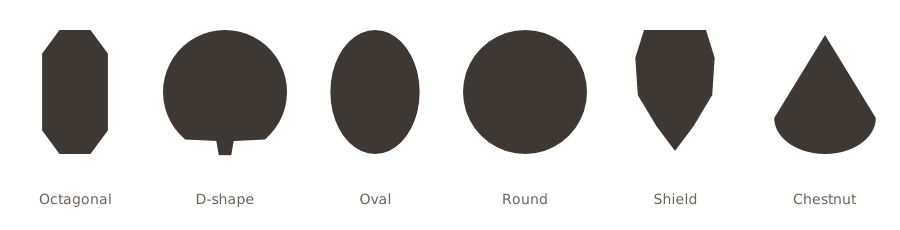
Octagonal. Eight flats, symmetric side to side, and the most common shape on modern double-bevel Japanese knives. The facets let your fingers find blade orientation without looking, and they resist rotation in a loose grip. Slightly less forgiving than oval if you hold the handle very tightly for long sessions, since the edges of the facets become contact points.
D-shape. Asymmetric by design, with a spine ridge that sits against the base of the index finger of the dominant hand. It shines on single-bevel knives where blade orientation is fixed for the whole stroke, which is why it is standard on yanagiba and deba. A right-handed D on a left-handed cook is genuinely uncomfortable, so check handedness before buying.
Oval and round. Neutral shapes with no orientation cue. Oval is the more refined of the two and is often described as the most comfortable in a relaxed grip. Round is the plainest option, easy to produce, and completely indifferent to how you hold it.
Yo handle features
Bolster. A thicker collar of steel or other material between blade and handle. It adds mass behind the heel, protects the fingers, and reinforces the junction. A full bolster that wraps the heel makes sharpening the last few millimetres of the edge awkward over time and is a common complaint on German-style knives; a half bolster or no bolster avoids it.
Rivets. Usually three on a modern kitchen knife. Rivet count correlates more with style and scale thickness than with strength. Mosaic and decorative rivets are cosmetic. Rivets can back out slightly on heavily used knives, which shows up as a rough spot under the palm.
Encapsulated and molded handles. The material is formed around the tang with no seams or rivets. Very easy to clean and common on food-service knives. Effectively unrepairable.
Handle and ferrule materials
| Material | Type | Weight | Water tolerance | Maintenance |
|---|---|---|---|---|
| Ho (Japanese magnolia) | Natural wood | Very light | Low | Oil occasionally, keep dry |
| Rosewood | Natural wood | Medium | Medium | Occasional oil |
| Ebony | Natural wood | Heavy | Medium | Occasional oil |
| Chestnut, oak, walnut | Natural wood | Light to medium | Low to medium | Occasional oil |
| Stabilized wood | Wood plus resin | Medium | High | None to speak of |
| Pakkawood | Wood plus resin | Medium | High | None |
| Micarta | Fabric or paper in resin | Medium | High | None |
| G10 | Fiberglass in resin | Light to medium | Very high | None |
| POM and other plastics | Synthetic | Light | Very high | None |
| Stainless steel | Metal | Heavy | Very high | None |
| Buffalo horn | Natural, ferrules mostly | Light | Low | Keep dry, can crack |
Ho wood. The default wa handle wood on most production Japanese knives: pale, very light, straight-grained, and cheap enough that makers treat it as a consumable. It absorbs oil readily and is easy to shape, which is why entry-level knives ship with it and why rehandling a ho-handled knife is a common first upgrade. It is not durable. Expect it to darken, dent, and eventually loosen at the ferrule with daily use.
Ebony and rosewood. Dense tropical hardwoods used on mid and upper-tier wa handles, usually paired with a buffalo horn ferrule. Both are far more dent-resistant than ho and add noticeable mass at the back of the knife, which pulls the balance point rearward. Ebony is the harder and darker of the two. Sourcing on both is increasingly restricted, so substitutions are common.
Stabilized wood and burl. Natural wood impregnated with resin under vacuum and pressure. It keeps the grain and figure of the original wood while becoming dimensionally stable and effectively waterproof. This is the standard material for custom wa handles and premium yo scales. Heavier than untreated wood of the same species.
Pakkawood. Layered hardwood veneers compressed with resin. Non-porous, dimensionally stable, inexpensive, and the most common handle material on mass-market Japanese knives sold abroad. It looks like wood at a distance and does not behave like it, for better and worse. Chips rather than dents if dropped on tile.
Micarta and G10. Both are resin laminates: micarta uses linen, canvas, or paper, G10 uses woven fiberglass. Micarta develops a slightly warm, grippier surface with use and is the more common of the two on kitchen knives. G10 is harder, lighter, and close to indestructible, but can feel cold and plasticky. Both grip well wet or greasy and both are unaffected by water. Micarta can delaminate at a rivet edge after many years of hard use (reported, not common).
Plastics and metal. POM and reinforced nylon are the workhorse materials of commercial food service: cheap, hygienic, dishwasher-tolerant, and unremarkable in the hand. All-stainless handles are hygienic and durable but heavy, slippery when wet unless textured, and unpleasant to hold at temperature extremes.
Ferrules. The collar at the front of a wa handle, whose real job is keeping the wood from splitting when the tang wedges in. Buffalo horn is traditional and the mark of a better handle, though it can dry and crack if soaked or stored hot. Plastic ferrules are standard on budget knives and are functionally fine. Decorative spacers of horn, resin, or metal between ferrule and body are cosmetic.
Fit and sizing
There is no standard. As rough orientation, wa handles on 210 to 240 mm gyuto usually run somewhere around 115 to 135 mm long, with the taller cross-section dimension in the low 20s of millimetres, but this varies widely by maker and is worth checking against a handle you already like rather than against a number.
What actually matters:
- Hand size and grip. If you pinch grip, the handle mostly stabilizes and steers, so a slim handle is fine. If you hold back on the handle, girth and shape matter far more.
- Length. Too short and the butt digs into the palm in a rearward grip. Too long and it catches your forearm on tall knives.
- Balance. Handle weight is the easiest lever for moving a knife's balance point. A heavy ebony or resin handle can turn a blade-forward knife into a neutral one, and a light ho handle does the reverse.
Care and rehandling
Bare wood handles: wash quickly, dry immediately with the same towel as the blade, never soak, never put in a dishwasher. Every few months, wipe on a small amount of food-safe mineral or camellia oil if the wood looks dry. Heat and steam are what loosen ferrules and open cracks. Synthetic and stabilized handles need none of this.
Rehandling is one of the reasons people commit to wa. A worn ho handle can be replaced with a custom in stabilized burl, ebony, or micarta for a fraction of the cost of a new knife, and it changes the balance and feel more than most people expect. Removal usually involves heating the tang gently and tapping the handle off, and the original often survives. Yo scales can also be replaced but the process destroys the old scales and requires drilling and re-riveting.
Choosing
- Cook in a busy or commercial kitchen, or hate maintenance: yo with synthetic scales, or wa in pakkawood or stabilized wood.
- Want the blade to feel light and forward, and like the idea of changing handles later: wa.
- Right-handed and buying a single-bevel knife: D-shape is the traditional and usually the better answer.
- Left-handed: avoid D-shape unless it is specifically made left-handed. Octagonal and oval are ambidextrous.
- Unsure: octagonal wa in stabilized wood or micarta is the least likely choice to regret.
Sources: user reference document (Knife_doc); SharpEdge, Kasumi Japan, Seido Knives, Cutlery and More, LeeKnives, Japanese Knife Lab, Atumuryou, Knivesworld handle guides.