Sakai Smiths
Two things define a Sakai knife before you get to any individual smith. The first is geometry: the region's house style runs light and thin, with real distal taper from heel to tip, a shallow convex or flat grind, and soft iron cladding on most carbon work. The second is finish, which is generally the most refined of the four regions. If a knife feels precise and slightly delicate in the hand, Sakai is the usual answer.
One buying note that catches people out: Sakai length is conventionally measured from the machi, the step where the blade meets the tang. A Sakai knife therefore carries roughly 10 to 15 mm less usable edge than the same nominal size from Sanjo or Echizen. Compare across regions accordingly.
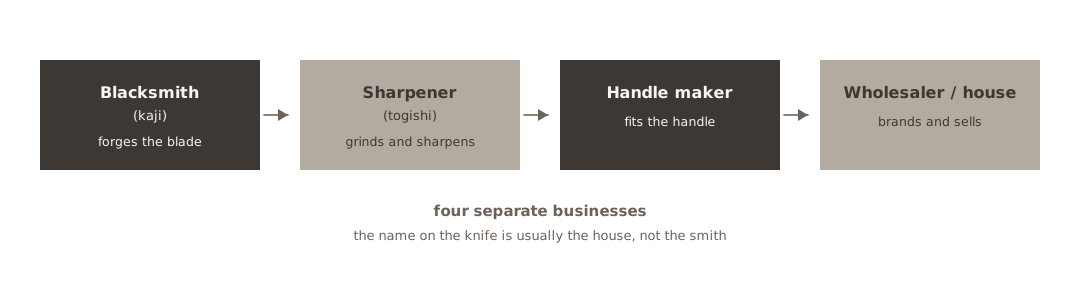
The other structural fact about Sakai is the division of labor. Forging, sharpening, and handle fitting are separate trades handled by separate craftsmen, then assembled and sold under a house name. A Sakai knife is usually a smith plus a togishi plus a house, which is why the same smith's steel turns up under a dozen different brands. The smiths below are covered here; their sharpeners are in the sharpeners section and the brands that sell their work are in the houses section.
Quick Reference
| Smith | Best known for | Steels commonly seen | Sold under |
|---|---|---|---|
| Ashi Hamono | Monosteel lasers, thinness | Shirogami 2, Swedish stainless, Ginsan | Ginga, Gesshin Ginga, Konosuke |
| Itsuo Doi | Low-temperature forging, Blue 2 | Aogami 2, Shirogami | Sakai Takayuki (Homura, Genbu, Guren) |
| Kenji Togashi | Honyaki, traditional single bevel | Shirogami 1 and 2, Aogami | Sakai Takayuki, Hitohira |
| Mizuno Tanrenjo | Heritage forge, traditional wa-bocho | Shirogami, Aogami | Mizuno Tanrenjo (own name) |
| Satoshi Nakagawa | Wide bevels, honyaki, stainless range | Ginsan, Aogami 1 and 2, VG10, Shirogami | Hitohira, Hatsukokoro, Sakai Takayuki, Kikumori |
| Yasuhiro Hirakawa | Scissors first, knives alongside | not documented | Sasuke |
| Yoshikazu Ikeda | Honyaki and the Sakai hamon | Shirogami 1 to 3, Aogami 2, Aogami Super | Sakai Hokushin, Yoshihiro, Ninohi |
| Yoshikazu Tanaka | Charcoal-quenched carbon, heat treatment | Shirogami 1 and 2, Aogami 1 and 2 | Konosuke Fujiyama, Hado, Kagekiyo, Hitohira |
Working Smiths
Ashi Hamono (Hiroshi Ashi) Established in Sakai in 1948 and headed by Hiroshi Ashi. Unusual among Sakai workshops in two ways: it produces entirely in house rather than farming out sharpening, and it builds monosteel blades (zenkou construction) rather than clad ones. The Ginga line is the reference point for the Sakai laser, thin and precise in both carbon and stainless. If you want to know what people mean by a thin Sakai grind, this is the archetype. The trade-off is the usual laser trade-off: excellent food separation and effortless push cutting, but little heft for hard produce and less margin for careless technique. Ashi also does the sharpening on its own blades, which is why the line is unusually consistent unit to unit. Ashi is commonly reported to have forged some Konosuke Fujiyama honyaki, though the Fujiyama attribution history is contested.
Itsuo Doi Son of Keijiro Doi, who was one of the most influential Sakai smiths of the last century. Itsuo began apprenticing under his father at 24 and has now been forging for more than 40 years. He is the head blacksmith at Sakai Takayuki, which built him his own workshop, and his work appears in the Homura, Genbu, and Guren lines. His calling card is Aogami 2 worked with his father's low-temperature forging method and finished with the classic Doi polish. Community consensus is that his Blue 2 has very few peers for edge feel and ease of sharpening. Sources describe him as involved in both forging and sharpening, though he is documented more clearly as a forger. He has said he will be the last of the family to make knives.
Kenji Togashi One of the small number of Japanese smiths with the skill to forge honyaki consistently well, and generally described as a master of the Sakai forge. He works with his three sons and forges mainly for Sakai Takayuki, with some work reaching Hitohira. He holds Dentokogeishi (Master of Traditional Crafts) status and has received the Order of the Sacred Treasure. His workshop includes an in-house sharpener, reported to be his son Kenya Togashi, which is unusual in Sakai's split-trade system and gives the Togashi lines an unusually consistent forge-to-edge signature. Expect traditional single bevels and mirror-polished honyaki with a visible hamon rather than modern stainless work.
Mizuno Tanrenjo Founded in 1872 by mastersmith Torakichi Mizuno and still family run, with the third, fourth, and fifth generations (Akiharu, Yasuyuki, and Jyun Mizuno) documented. The workshop forges Japanese swords alongside kitchen knives, and its kitchen output is best known for traditional Sakai-uchi wa-bocho. The second generation, Masanori Mizuno, was commissioned to forge the Mayokegama sickle for Horyuji Temple, and imperial visits to the workshop in 1952 and 1980 are commemorated by the 賜台覧 mark engraved on blades. This is a heritage forge rather than a modern-steel one: single bevels, classic carbon steels, and traditional shapes. Unlike most Sakai smiths, Mizuno sells largely under its own name rather than through houses.
Satoshi Nakagawa (Nakagawa Hamono) Trained under Kenichi Shiraki at Shiraki Hamono for 16 years as his only apprentice, then took over when Shiraki retired and closed the shop; Nakagawa launched under his own name in April 2021. He specializes in wide-bevel work and forges honyaki, and he is one of the few Sakai smiths comfortable in stainless (Ginsan and VG10) as well as the carbon steels. The reputation rests on heat control during forging and thorough heat treatment: good edge formation, long edge life, and carbon steels that stay easy to sharpen. His steel appears under Hitohira, Hatsukokoro, Sakai Takayuki, and Sakai Kikumori among others. Opinions differ on where he sits relative to the older masters, but the common read is that he is the most versatile smith of the current generation.
Yasuhiro Hirakawa (Sasuke) A fifth-generation Sakai blacksmith whose primary business is scissors, with kitchen knives made alongside them and priced well below the region's marquee names. He is known for welcoming visitors into the workshop. This entry rests almost entirely on visitor reports rather than maker or retailer documentation, so treat the generation count and the details of his knife work as reported, not confirmed.
Yoshikazu Ikeda (Ikeda Tanrenjo, Sakai Hokushin) Born 1946, kanji 池田美和, and by common agreement the most celebrated living smith in Sakai. He began in 1967 as an apprentice to his father Kameo Ikeda, second generation of the family forge, and founded his own workshop, Ikeda Tanrenjo, in 1983 after his elder brother Tatsuo took over the family shop. He is the current chairman of the Sakai traditional craftsmen's association. The Ikeda brothers are the honyaki reference in Sakai and are credited with pioneering the region's signature wave and Mount Fuji hamon. Now approaching 80, he is still producing honyaki in a wide range of carbon steels. His work is sold under his own Sakai Hokushin line and he is the principal smith behind Yoshihiro and Ninohi. Traditional single bevels and honyaki rather than stainless.
Yoshikazu Tanaka More than 50 years at the forge, certified a Sakai Master Craftsman in 1996, and working alongside family (sources disagree on two sons versus a son and an apprentice). The technical signature is old-method heat treatment executed well: pine charcoal quenching, quench timing judged by eye rather than instrument, a tempering kiln, and output deliberately capped at roughly 30 knives a day. The result is heat treatment that community consensus rates among the best in Sakai, particularly in Hitachi carbon steels. He forges for Hado, Kagekiyo, Sakai Kikumori, Hitohira, Konosuke, and Sakai Takayuki, and he is the smith behind the clad Konosuke Fujiyama knives. One source reports he may retire soon (reported, not confirmed).
Retired and Historical
Kenichi Shiraki (Shiraki Hamono) Kanji 白木健一. One of Sakai's most revered smiths and a specialist in honyaki, including mizu-honyaki, the water-quenched version that is the hardest thing a Japanese smith is routinely asked to do. He retired and closed the workshop in 2020, handing the business to his only apprentice, Satoshi Nakagawa. His blades are out of production and now trade at collector prices. He matters here for two reasons: the Nakagawa lineage runs directly through him, and he is one of the smiths commonly named behind Konosuke Fujiyama honyaki, though that attribution is community reporting rather than confirmed.
Tatsuo Ikeda Elder brother of Yoshikazu Ikeda and third-generation head of the family forge, which the first-generation Tatsuzo Ikeda established in Sakai in 1888. Tatsuo entered the trade in 1954, succeeded to the workshop in 1975, and was recognized as a Traditional Craftsman (Dentokogeishi) in 1985. Like his brother he is best known for honyaki, and the two of them together are the reason Sakai honyaki has the reputation it does. He has passed away and his blades are collector items rather than working purchases, but his name appears often enough in older listings and forum threads that it is worth knowing whose work it is.
Related: Steel Supply
Tanabe Tatara is a steelmaker rather than a knifemaker, but its tamahagane reaches the market as Sakai knives, including blades forged by Yoshikazu Tanaka and ground by Masaya Shimizu. Covered in the steels section.
Sources
Real Chef Knives Wiki (reference doc, whose Sakai and Sanjo rosters appear to derive from naturalwhetstones.com); project NAMES registry; Bernal Cutlery; Knifewear; Knives and Stones; Burrfection Store; Kireaji; Chubo Knives; Hocho Knife; Hitohira; Kitchen Knife Forums and Chefknivestogo forums (community reporting, flagged where used).