Grinds and Heat Treatment
Steel gets most of the attention and deserves the least of it. Two knives cut from the same bar of the same steel can behave nothing alike, because the grind decides how the blade moves through food and the heat treatment decides what the edge does once it gets there. Everything below assumes the same rule that governs the rest of this guide: it is all compromise.
Grinds
A grind is the geometry of the blade from spine to edge. The edge angle determines how easily the knife starts a cut. The grind determines everything that happens after that, as the rest of the blade has to follow the edge through the food.
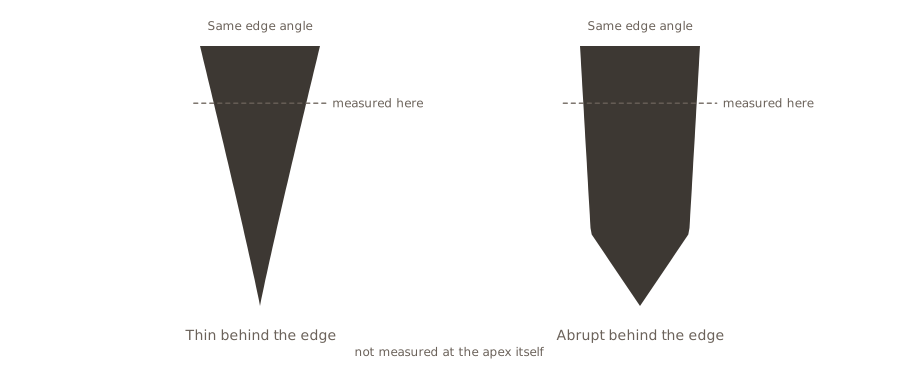
This is why a knife can shave arm hair and still fail on an onion. The edge penetrates, then the shoulders of the blade have to displace the two halves. If there is too much steel too close to the edge, the blade stops cutting and starts splitting, which is wedging. Thin behind the edge, usually measured a few millimetres up from the apex, matters more than the edge angle itself and more than the spine thickness people quote.
Thin behind the edge. The single most useful number nobody publishes. A blade can have a thick spine and still cut beautifully if the taper down to the edge is well managed, and a thin spine can wedge badly if the last few millimetres are abrupt. Choil shots (a photograph looking straight down the blade at the heel) are the standard community workaround for seeing this before buying. A retailer that posts choil shots is telling you something.
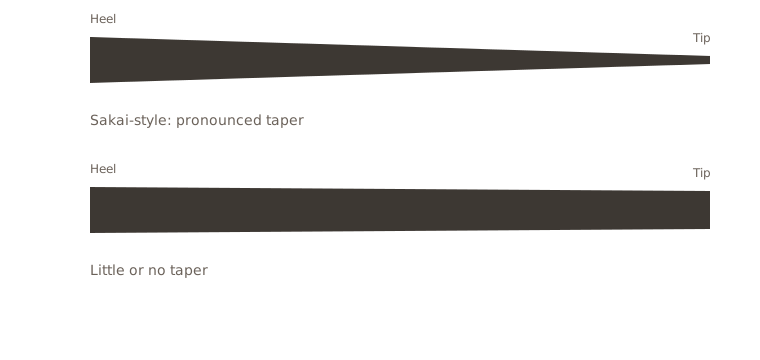
Distal taper. Thinning of the spine from heel to tip. It moves weight back toward the hand, makes the tip more delicate and more precise, and is a fair proxy for how much hand work went into the blade. Sakai knives are commonly described as having pronounced distal taper, Echizen knives as having little or none.
Food release. Whether the slices fall away or stick to the blade. Release comes mostly from geometry, with finish and the food itself contributing. Broadly, geometry that releases well is geometry with some convexity or relief near the edge, and it tends to wedge slightly more. Blades that are flat and slick are gentler entering the food and worse at letting go of it. Opinions differ on how much of release comes from finish versus grind.
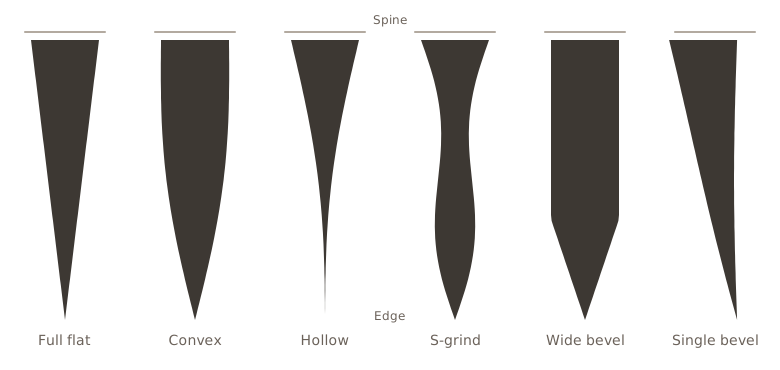
Full flat. A straight taper from spine (or from the shinogi) down to the edge. The most common kitchen geometry, an honest all-rounder, and the easiest to keep in shape over years of sharpening. Tends toward suction on starchy foods.
Convex. The faces bow outward toward the edge. Puts more steel behind the edge, so the edge is better supported, and the outward curve pushes food away, so release is usually better. The cost is more wedging in dense produce and a grind that is harder to thin correctly on stones. Common in kitchen knives described as workhorses. Note that some general knife literature calls convex useful only in axes and choppers, which does not reflect kitchen practice.
Hollow / concave. The faces are ground with a curve inward, traditionally on a large wheel. Removes material high on the blade, which reduces drag and helps release, and it keeps the blade from thickening as fast as it is sharpened down. Less steel supporting the edge. Common in Echizen work.
S-grind (compound). A hollow high on the blade transitioning into convexity near the edge. The aim is release from the hollow plus edge support and stiffness from the convex portion. Achieved by grinding on a large radius platen or wheel, or hammered in during forging. Expensive to execute well and mostly seen from individual makers.
Wide bevel (saber). The primary grind starts partway down the blade rather than at the spine, leaving a visible transition line (the shinogi on Japanese knives). Leaves stock high on the blade for stiffness and gives a distinct, often very good cutting feel. Wide bevels take real effort to maintain: as the knife is sharpened and thinned, the bevel must be reset or the knife slowly gets thicker behind the edge.
Single bevel (chisel). Ground on one side only, with a hollowed back (urasuki) on traditional Japanese single bevels. Steers into the cut, which is the point for yanagiba and usuba work where you want the slice to fall clean away. Handed, so left-handed versions must be ordered as such, and sharpening is a genuinely separate skill.
Asymmetry. Many double-bevel Japanese knives are deliberately asymmetric, commonly described in ratios such as 70/30. The intent is steering and release. The risk is the owner sharpening both sides evenly and quietly erasing the geometry the maker built.
| Grind | Steel behind edge | Food release | Sharpening/thinning | Typical use |
|---|---|---|---|---|
| Full flat | Moderate | Fair to poor | Easy | Most gyuto, general purpose |
| Convex | High | Good | Harder, needs care | Workhorses, dense produce |
| Hollow | Low | Good | Easy, stays thin | Echizen knives, slicers |
| S-grind | Moderate at edge, low above | Very good | Difficult to preserve | Maker-driven, premium |
| Wide bevel | High above bevel | Good | High maintenance, reset bevel | Sanjo and Sakai styles |
| Single bevel | Asymmetric | Very good (urasuki) | Specialist skill, handed | Yanagiba, usuba, deba |
Heat Treatment
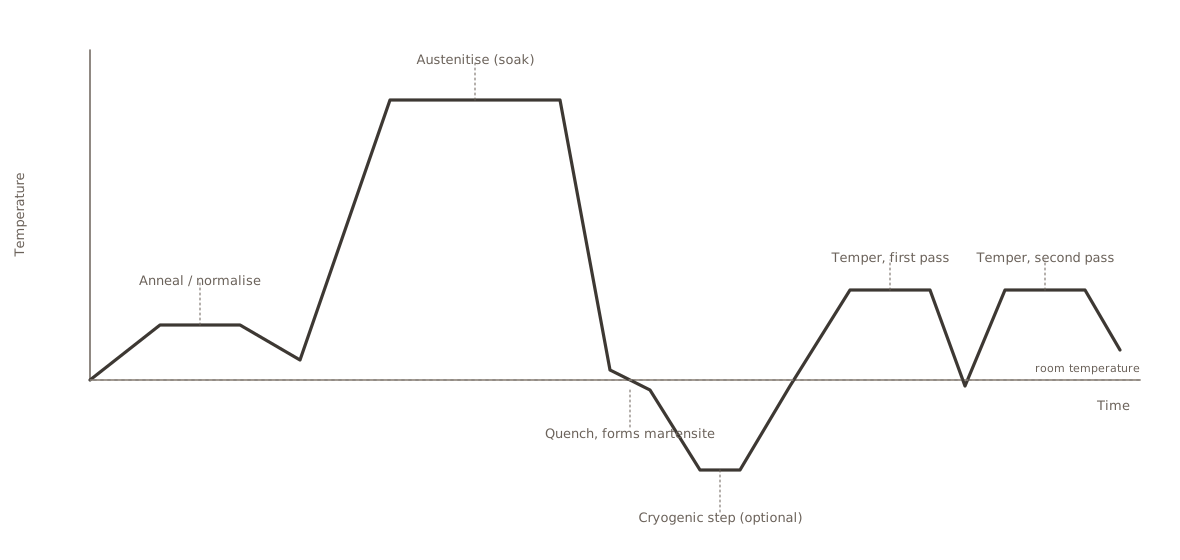
Heat treatment is the sequence of controlled heating and cooling that turns a soft, workable bar into hardened blade steel. It sets hardness, toughness, grain size and, indirectly, how fine an edge the steel will take and hold. It is the part of a knife you cannot inspect, cannot verify from a spec sheet, and cannot fix afterward.
The sequence. In outline, most blades go through some or all of the following.
| Step | What happens | Why it matters |
|---|---|---|
| Anneal / normalize | Heat and cool slowly or in cycles | Softens for working, refines grain, relieves stress |
| Austenitize | Hold at high temperature (soak) | Dissolves carbides, puts carbon into solution |
| Quench | Cool rapidly in water, oil, air or plates | Forms martensite, the hard phase |
| Cryogenic / sub-zero | Chill well below freezing, often liquid nitrogen | Converts retained austenite to martensite |
| Temper | Reheat below the critical point, usually twice | Trades a little hardness for toughness and stability |
Two variables inside that sequence account for most of the difference between a good heat treat and a mediocre one. Soak temperature and time control how much carbon goes into solution and how much grain growth occurs. Too cold or too short and the steel never reaches its potential; too hot or too long and the grain coarsens, which costs toughness and edge stability. Quench speed has to suit the steel: shirogami and other low-alloy carbon steels need a fast quench (water for some, which is why water-quenched blades warp and crack at a high rate), while high-alloy and powder steels harden in oil, plates or air.
Retained austenite. Not all austenite converts to martensite in the quench. What remains is softer, can transform later under stress, and is generally unwanted at the edge. Sub-zero or cryogenic treatment converts it. For several high-chromium stainless steels this step is effectively required to hit rated hardness.
Hardness and toughness. The core trade-off. Higher hardness generally buys better edge retention and the ability to hold a thinner, keener edge; it costs toughness, meaning resistance to chipping. HRC is a real measurement but a poor summary: 62 HRC on well-managed fine grain behaves very differently from 62 HRC with coarse grain and leftover retained austenite. A blade can be both hard and reasonably tough, and that combination is what good heat treatment is buying.
Grain size. Finer prior austenite grain improves toughness at a given hardness, which is why forging practice, normalizing cycles and controlled soaks matter and why some smiths are worth seeking out for a plain steel. This is the mechanism behind the common enthusiast claim that a good maker's 52100 or white #2 outperforms a mediocre maker's powder steel.
Cladding. Most Japanese kitchen knives are laminated: a hard core steel (hagane) with softer jacket steel (jigane) forge welded to it. San mai has the softer layers welded to both faces; warikomi has the jacket split and the core inserted, so the soft steel also wraps the spine. Cladding lets a maker run a very hard, brittle core without the whole blade being brittle, makes the knife easier to sharpen and thin, and can be soft iron (reactive, patinas, prized for how it feels on stones) or stainless (lower maintenance). The core is doing the cutting.
Differential hardening (honyaki). A monosteel blade quenched so that the edge hardens fully while the spine does not, traditionally by coating the spine in a thicker layer of clay before the quench. The result is a hard edge with a softer, more forgiving spine and a visible hamon line high on the blade. Mizu (water quenched) honyaki has a high failure rate in the shop, which is a large part of why these knives are what they are. Whether honyaki cuts measurably better than an equivalent clad blade is contested; the craftsmanship and the finish are not.
Terminology warning: kasumi is used both for clad construction and for the misty polish that clad knives take, and usage varies by shop. A lamination line sits low on the blade near the edge; a hamon sits high, near the spine. That is the reliable way to tell them apart.
What you can actually do with this. Very little, directly, which is the honest answer. Heat treatment is invisible, so in practice enthusiasts buy the maker rather than the spec. Track smiths whose blades hold up, treat HRC figures as one data point among several, and treat a spec sheet listing an impressive steel with no information about the maker as telling you nothing about performance.
Sources: A.G. Russell grind reference (via project reference document), Knife Steel Nerds (Larrin Thomas) on cryogenic processing and heat treat protocols, Knifewear on honyaki and differential hardening, Element Knife Company on san mai and warikomi construction, zknives Japanese knife terminology, Topham Knife Co on S-grinds, Kitchen Knife Forums and ChefKnivesToGo Forums threads on food release, honyaki versus kasumi, and lamination lines, Wikipedia on Japanese kitchen knife geometry (urasuki, shinogi).