Echizen (Takefu) Smiths
Echizen City, Fukui Prefecture. One of the three centres usually named alongside Sakai and Seki, and the one most associated with double-bevel kitchen knives sold under the maker's own name rather than under a wholesaler's.
About the region
Echizen blade-making is conventionally dated to 1337, when the Kyoto swordsmith Chiyozuru Kuniyasu settled in what is now Echizen City (historically Takefu) and began forging sickles for local farmers alongside swords. The area became a major producer of agricultural tools, and Edo-period records list Fuchu (Takefu) sickles and nata among regional products. In 1979 Echizen Uchihamono became the first cutlery craft in Japan to receive national Traditional Craft designation.
Two names cause confusion. "Echizen" is the province and the modern city; "Takefu" is the older name for the town at its centre, and both are still used interchangeably on maker pages and retailer listings. A knife marked Echizen and a knife marked Takefu are from the same place.
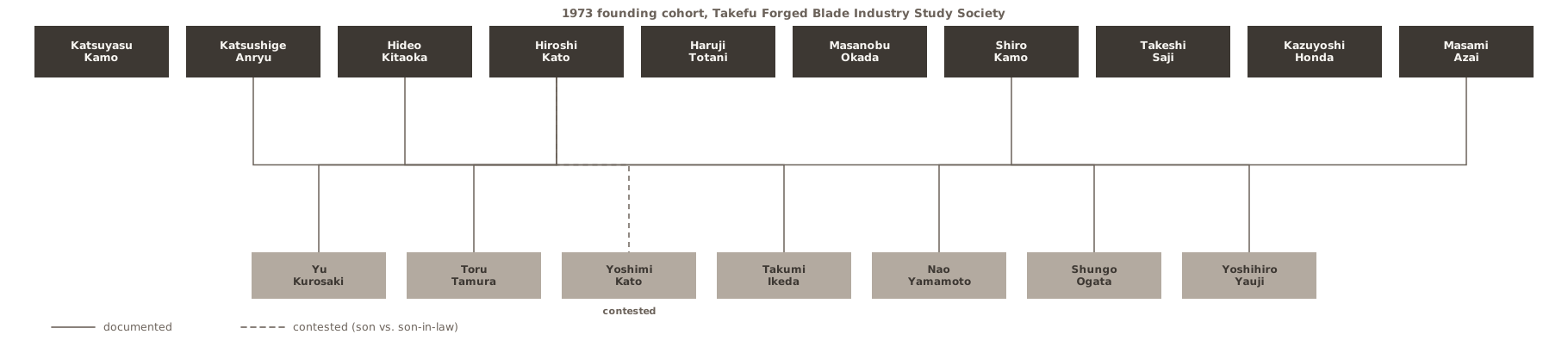
The modern reputation of the region rests heavily on one institution. In the 1970s Echizen smiths faced aging workers, few successors, falling demand for hand-forged farm tools, and competition from stamped stainless. In 1973 a group of younger craftsmen formed the Takefu Forged Blade Industry Study Society. Founding members are usually listed as Katsuyasu Kamo, Katsushige Anryu, Hideo Kitaoka, Hiroshi Kato, Haruji Totani, Masanobu Okada, Shiro Kamo, Takeshi Saji, Kazuyoshi Honda, and the late Masami Azai. In 1982 they began working with industrial designer Kazuo Kawasaki, a local, on a unified brand and a modern product line; a first collection of 17 items was exhibited in Tokyo in 1983. In May 1993 the physical cooperative facility, Takefu Knife Village, was completed, designed by architect Kiko Mozuna. The smiths financed it themselves without subsidy.
What that produced is a shared-facility model rather than the Sakai division of labour. In Sakai, forging, sharpening, and handle-fitting are typically done by three separate specialists coordinated by a wholesaler. In Echizen, individual workshops keep their own names and usually handle forging and grinding in-house or within the cooperative, and sell under the smith's own name. This is the main structural reason Echizen names are so recognisable to Western buyers: you are usually buying "a Kurosaki" or "an Anryu," not "a Konosuke."
Two further consequences follow. First, apprenticeship lines here are unusually legible, and most of the current generation trace back to a small number of founders (Hiroshi Kato and Katsushige Anryu especially). Second, Echizen adopted modern steels early and enthusiastically. VG-10, SG2/R2, and Aogami Super are all common, and several workshops built their reputations on hand-forging powdered stainless, which is technically awkward and not widely attempted elsewhere. Traditional carbon single-bevel work continues, but it is a minority speciality within the region.
Reference table
| Smith / workshop | Base | Lineage or founded | Status | Associated with |
|---|---|---|---|---|
| Hiroshi Kato | Takefu Knife Village | 2nd gen, Kanehiro | Retired (succeeded 2017 to 2018) | Village founder, teacher of Kurosaki and Tamura |
| Yoshimi Kato | Takefu Knife Village | 3rd gen, Kanehiro | Active | SG2 black damascus, Kintaro, Masakage |
| Kanehiro Uchi Hamono | Takefu | Founding year disputed | Active | Kato family workshop, Kintaro brand |
| Katsushige Anryu | Takefu Knife Village | 4th gen, family line from 1870s | Retired 2021 | Aogami Super kurouchi, Masakage Mizu |
| Takumi Ikeda | Takefu Knife Village | 5th gen Anryu, from 2021 | Active | Continues the Anryu line |
| Takeshi Saji | Takefu Knife Village | 4th gen, b. 1948 | Active (reported) | Rainbow damascus, exotic handles, R2/VG-10 |
| Kazuo Nomura | Takefu | Saji Uchihamono, successor generation | Active | Saji-brand forging, Traditional Craftsman 2020 |
| Yu Kurosaki | Takefu Knife Village | Own workshop 2014 | Active | Senko, Shizuku, Fujin, Raijin, tsuchime finishes |
| Shiro Kamo | Takefu Knife Village | 2nd gen, Kamotou Hamono | Active | Hand-forged powdered stainless, kurouchi |
| Katsuyasu Kamo | Takefu Knife Village | 2nd gen, Kamo Hamono, b. 1941 | Active (reported) | Vegetable-harvesting blades, first cooperative chairman |
| Hideo Kitaoka | Takefu Knife Village | 3rd gen | Active | Single-bevel specialist, Blue #2 |
| Yoshihiro Yauji | Takefu Knife Village | Own workshop 2021 | Active | Kutsurogi, single-bevel |
| Takamura Hamono | Echizen City | Founded 1945 | Active | Forged stainless, R2 lasers |
| Ryusen Hamono | Echizen City | Founded approx. 1950s | Active | Blazen, Bonten Unryu, steak knives |
| Kunio Masutani | Echizen City | 4th gen, Masutani Hamono, b. 1944 | Active | Kunihira, affordable VG-10 and V1-Gold |
| Takayuki Iwai | Takefu | Firm from 1939 | Active | Traditional Craftsman 1994 |
| Masanobu Okada | Takefu Knife Village | 3rd gen Echizen Monjiro, b. 1949 | Active (reported) | Sickles and shears, older Echizen forging methods |
| Nao Yamamoto | Takefu Knife Village | Successor to Masami Azai | Active (reported) | Continues the Asai name |
Entries
Hiroshi Kato Founder-generation figure and, indirectly, the reason a lot of the current Echizen roster exists. He ran the family workshop, Kanehiro Uchi Hamono (Kato Knife Manufacturing), in Takefu and is listed among the roughly ten smiths who founded the cooperative completed in 1993. One retailer source says he became the fourth chairman of Takefu Knife Village in 1994 (single-source, not corroborated). He was awarded the Order of the Sacred Treasure, Silver Rays, in 1987. His apprentices include Yu Kurosaki, Makoto Kurosaki, and Toru Tamura, which is an unusually strong teaching record for one forge. Sources disagree on whether his successor Yoshimi Kato is his son or son-in-law; "son-in-law" is the more commonly cited version and appears in a first-person quote attributed to Yoshimi, but the conflict is unresolved. He handed the forge over gradually around 2017 to 2018 and is no longer forging.
Yoshimi Kato Successor to Hiroshi Kato and now the smith behind the Kanehiro and Kintaro lines, as well as several Masakage series. He came to the trade late, having previously worked as a project manager in construction, and learned through apprenticeship rather than growing up in the forge. He is best known internationally for SG2 (R2) work, particularly the black damascus finish, and for consistent heat treatment across a wide range of steels: VG-10, Shirogami, Aogami Super, and powdered stainless all appear in his output. The knives are cleanly finished, thin behind the edge, and aimed squarely at working cooks rather than collectors. Everyday-user reputation is strong; there is no cult of scarcity around them the way there is around some Sanjo makers.
Kanehiro Uchi Hamono The Kato family workshop entity, as distinct from the individual smiths. Founder is given as Kintaro Kato, and the workshop trades as Kanehiro and Kintaro. Founding dates conflict across sources and are worth flagging rather than resolving: one account gives family knife production starting 1928 with the company formally founded in 1958, another dates the firm to 1948. All accounts agree on the generational chain of Kintaro to Hiroshi to Yoshimi. The workshop operates within Takefu Knife Village and supplies knives under multiple names, which is why the same hands turn up under Kanehiro, Kintaro, and several Masakage lines.
Katsushige Anryu Fourth-generation smith of a family knife-making line that traces to the 1870s. He joined the family business in 1959 straight out of high school, apprenticed under his father Katsutoshi, and was a founder and later chairman of the Takefu cooperative. His signature work is Aogami Super clad in soft iron with a rough kurouchi finish, thick at the spine and thinned aggressively toward the edge; the look is deliberately unpolished and the geometry is more workhorse than laser. He also forged the Masakage Mizu line. He stepped back and retired in 2021, handing the forge to his nephew and long-time apprentice Takumi Ikeda. Blades sold as Anryu today are Ikeda's work.
Takumi Ikeda Fifth-generation head of Anryu Hamono. Unusually for the region, he is not from a blade-making background: born and raised in Yokohama, he moved to Echizen in 2007 and apprenticed under his uncle Katsushige Anryu. He was certified a Traditional Craftsman (Dento Kogei Shi) for kitchen knife making in 2020 and had already been forging most of Anryu Hamono's output for roughly three years before the handover. The succession date is reported as January 2021 in a dedicated account and as 2022 elsewhere; the earlier date comes from the more detailed source. Retailers describe his knives as effectively indistinguishable from Anryu's, which appears to be the deliberate intent rather than marketing shorthand.
Takeshi Saji Fourth-generation smith, born 1948, and one of the more visually distinctive makers anywhere in Japan. He worked from Takefu Knife Village, was certified a Traditional Master Craftsman in 1992, and returned his focus to kitchen knives in 2007. He is best known for coloured or "rainbow" damascus, exotic handle materials, and a willingness to forge steels that are difficult to work: VG-10, R2, Shirogami, and Aogami Super all appear in his lineup. The aesthetic is polarising and the knives are not cheap on the geometry-per-effort axis, but the heat treatment is well regarded. Sources describe him as still forging; one says "in his 80s," which does not square with a 1948 birth year, so treat the age framing as loose rather than the activity claim.
Kazuo Nomura Representative and president of Saji Uchihamono, the company behind the Takeshi Saji brand, and the person doing an increasing share of the forging as Saji ages. Certified a Traditional Craftsman in 2020. Sources disagree sharply on his relationship to Saji: some describe him as Saji's son, others as a long-time apprentice and handle maker, and one as a business partner of several decades. The generational framing is inconsistent too, with Saji given as third generation and Nomura as fourth on the same page that lists Naoya Saji and Kenta Nomura as fifth. Worth knowing about mainly because a knife stamped Takeshi Saji today may well be his work, the same situation as Anryu and Ikeda.
Yu Kurosaki Apprenticed under Hiroshi Kato and founded his own workshop in 2014. He is often described as the youngest recipient of the Master Nokaji (master blacksmith) title, though the exact framing varies by source. His output is organised into named lines with strongly differentiated finishes: Senko (rippled, mirror-adjacent), Shizuku, Fujin, Raijin, and Kokusen among them, with tsuchime and suminagashi treatments used heavily. The knives are thin, light, and finished to a high standard; opinions differ on whether the more dramatic hammered finishes help or hurt food release in practice. Widely available and a common first "name maker" purchase in the West. His older brother Makoto Kurosaki works in the same village as a sharpener and finisher.
Shiro Kamo Second-generation smith of Kamotou Hamono (also seen as Kamo Fuji Cutlery, founded 1955) and a Takefu Knife Village member. Born 1958, he learned from his father early and began forging knives himself at 25; sources give his Dento Kogei Shi certification at either 45 or 47. He is one of the small number of smiths who hand-forge powdered stainless steel rather than stock-removing it, which is his main claim on enthusiast attention. He works in Aogami Super, SG2, and Shirogami, usually with a kurouchi or damascus finish, and keeps a small crew while training successors. His blades supply house brands including Hatsukokoro.
Katsuyasu Kamo Second-generation smith of Kamo Hamono, born 1941 in what was then Takefu City, and the single most consequential organiser in the region's revival. He left Takefu High School in 1956 to study under his father Shintaro, co-founded the Takefu Forged Blade Industry Study Society in 1973, and served as first chairman of the Takefu Knife Village Cooperative. Certified a Traditional Craftsman in 2008; received the Order of the Sacred Treasure in 2016. His forging speciality is double-bevel work, and he is best known domestically for vegetable-harvesting blades developed with high-altitude farms in Nagano rather than for kitchen knives. He also drove the all-stainless integral handle seen on some of his knives. One source calls him third generation rather than second (reported, not confirmed). He is the older of two Kamos in the village, sometimes called Oh-Gamo, and is a different person from Shiro Kamo above.
Hideo Kitaoka Third-generation smith at Kitaoka Knife Manufacturing and, by the account of multiple retailers, the only smith in Takefu Knife Village specialising in single-bevel knives. That makes him an outlier in a region defined by double-bevel work. He learned from his father and has carried the family line for over 30 years, working mainly in Blue #2 with kasumi finishes on yanagiba, deba, and usuba. Awards include the Award for Successor of Traditional Crafts, a Japan Traditional Crafts Association Gold Award, a Minister of Economy, Trade and Industry Award, and the Order of the Sacred Treasure. Given his career length, retirement at some point is plausible, but no source reports it and his lines remain in regular distribution.
Yoshihiro Yauji Born 1983 in Echizen. He entered Kitaoka Knives in 2003 to apprentice under Hideo Kitaoka, acquired Traditional Craftsman certification in 2019, then left in April 2021 to set up his own workshop, Kutsurogi, within Takefu Knife Village. Like his teacher, he specialises in traditional single-bevel knives, which keeps a rare skill set alive in a region that has largely moved the other way. Output is small and distribution is thin outside a handful of retailers and the Hatsukokoro house lines. Worth knowing about mainly as the succession story for Echizen single-bevel work.
Takamura Hamono Founded 1945 and one of the oldest surviving knifemaking companies in Echizen. Forging and sharpening are both handled in-house. The workshop's reputation rests on being an early mover in forged stainless and, later, powdered stainless and powdered stainless damascus. The R2/SG2 lines are the reference point: very thin, very hard, ground to a fine edge, and generally described as "laser" geometry with the fragility that implies. Terukazu Takamura is identified as the current head blacksmith, with his father Toshiyuki and grandfather Isao before him; Toshiyuki received the Medal of Honour from the Emperor of Japan along with prefectural and national awards. Good food release is not what these are for; thinness is.
Ryusen Hamono A company rather than a single-smith workshop, based in Echizen City and described as having been founded over 70 years ago, with third-generation leadership under the Masutani family (Taiji Masutani as president, Koji Masutani as chairman). The catalogue is broad and design-forward: Blazen, Bonten Unryu, Bureizen, Tanganryu, Fukakuryu, and others, plus steak knives and non-kitchen cutlery. Ryusen sits closer to the polished, consumer-facing end of Echizen than the founder-generation forges do, and its work is often encountered through collaborations and retailer partnerships rather than under the Ryusen name alone.
Kunio Masutani (Masutani Hamono / Kunihira) Fourth-generation smith running a small Echizen house that occupies a segment none of the entries above cover: affordable, higher-volume stainless aimed at home cooks. Born 1944, he began under his father at 15 and opened his own shop around 30. He works mainly in VG-10 and V1-Gold in a deliberately small range of shapes to keep costs down, with most of the staff family. Following the departure of the smith they worked with, the hand-forged line was discontinued and production is now largely pre-laminated blanks stamped and ground in-house, so this is stock removal plus hand sharpening rather than forging (reported by a shop that toured the workshop in 2023). He is described as a brother or as a relative of Koji Masutani of Ryusen Hamono; sources use both words.
Takayuki Iwai The Iwai workshop has been making knives since 1939, and Takayuki Iwai received Traditional Craftsman certification in 1994. Documentation in English is thin: the available source emphasises that the knives are made by hand rather than mass-produced by machine, and does not give a generational chain or a current-status statement. Included here for completeness of the Echizen roster; anyone writing further on him should expect to work from Japanese-language sources or direct contact.
Masanobu Okada Third generation of Okada Uchihamono, born 1949, and since 1985 the holder of the Echizen Monjiro name. He learned from his father, himself an award-winning contemporary master craftsman. He is one of the few remaining smiths carrying the older Echizen forging techniques (mawashiho and maikozuchi, the folding method that works the billet to a rhomboid section). His output is mostly agricultural and specialist: sickles and pruning shears above all, with kitchen knives a comparatively recent and reluctant addition. He reportedly told one retailer he is not interested in making the knives the other village smiths make. Dento Kogei Shi certified, and received the Order of the Sacred Treasure in 2017. A useful counterweight to the impression that Echizen is entirely a kitchen-knife region.
Nao Yamamoto Successor to Masami Azai, one of the founding members of the Takefu group, and continues to produce knives under the Asai name from Takefu Knife Village. Described by retailers as an award-winning master blacksmith. Sourcing for this entry is retailer-only and thinner than for the other names above; the succession itself is consistently reported, but biographical detail, dates, and steel preferences could not be confirmed from a maker-side source.
Shungo Ogata A programmer before he entered the trade, Ogata apprenticed roughly seven years under Shiro Kamo as a sharpener, then went independent. He is filed here as a smith: sharpening into forging is a normal career progression in Echizen rather than a change of trade, and he is reported to still do his own grinding and finishing. Accounts of his process differ, with one retailer describing spring hammer forging and another describing blanks cut and heat treated by Takefu Special Steel with Ogata doing geometry and finishing; those may simply describe different points in his career or different lines. He is gaining prominence quickly.
Related entries elsewhere
- Makoto Kurosaki, older brother of Yu Kurosaki, trained under Hiroshi Kato and works in Takefu as a sharpener and finisher rather than a forger, under the Style-K name. He grinds for Yoshimi Kato, Takumi Ikeda, and his brother. See the sharpeners section.
- Toru Tamura apprenticed at Takefu Knife Village under Hiroshi Kato before returning to Tosa, where he forges for Tetsujin Hamono with sharpener Naohito Myojin. Filed under Tosa.
- Masakage is a house brand created in 2007 by sharpener Takayuki Shibata, drawing forged blades from Echizen smiths (Hiroshi Kato, Yoshimi Kato, Yu Kurosaki, Katsushige Anryu, Takeshi Saji, Takumi Ikeda) and sharpening them at Shibata's own workshop. Filed under houses.
- Kei Kobayashi is described by one retailer as an Echizen-based blacksmith and sharpener, but the stronger location evidence places him in Seki. Filed under Seki, with the conflict noted.
Sources
NAMES maker registry (project reference document); Takefu Knife Village official history; Fukui Prefecture and Discover Fukui craft pages; Samurai Museum Shop Echizen Uchihamono history; Cutting Edge Knives and Sharp Knife Shop Takefu Knife Village histories; Knifewear blacksmith profiles and retired-blacksmith article; Knives and Stones maker pages; Seisuke Knife maker pages; Carbon Knife Co., Chef Knives To Go, Bernal Cutlery, Tokushu Knife, SharpEdge, Hocho-Knife, District Cutlery, MyGoodKnife collection and profile pages; Ryusen Hamono and Takamura Knives own sites; Hagakure Shop Kitaoka and Okada profiles; Nihonmono Katsuyasu Kamo feature; Kamo Hamono, Masutani Hamono, and Saji Uchihamono retailer profiles (Cutting Edge Knives, Kaz's Knife, Burrfection Store, Japanese Knife Direct, Bay Trade Japan, CleanCut, Coltelleria Collini). Additional sources consulted for the later additions: Knife Art, Kataba, Nihonmono.