Sanjo Smiths
Sanjo (Niigata)
Sanjo sits on the Igarashi and Shinano rivers in central Niigata. The local story is that repeated flooding wrecked farming, and in the 1620s farmers were taught nail forging as off-season work. New forging techniques arrived from the Aizu area around 1661, and the trade broadened from nails into sickles, saws, and kitchen knives. Merchants moved the output downriver, and the town became known nationally for hardware. Sanjo and neighbouring Tsubame are usually treated together as one industrial district, "Tsubame-Sanjo," though the knife makers below are Sanjo proper.
What distinguishes Sanjo from Sakai is the structure of the trade rather than any single technique. Sakai runs on division of labour, with separate forging, sharpening, and handle houses coordinated by a wholesaler. Sanjo workshops much more often do everything in house: forge, grind, heat treat, finish, and fit the handle under one roof. That shows up in the knives. Sanjo output skews toward double-bevel kitchen knives with thick spines, distal taper, and convex grinds, and toward rustic finishes such as kurouchi and nashiji rather than the mirror-polished wide bevels associated with Sakai. Iron-clad carbon steels (Shirogami, Aogami, Aogami Super) remain the core, though stainless cladding and semi-stainless cores such as SLD are now common.
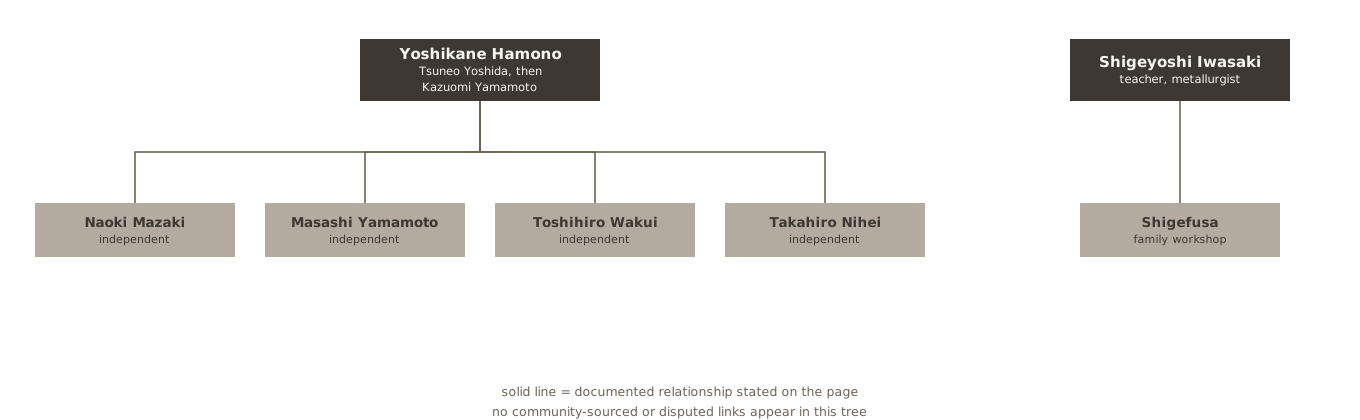
Sanjo is also unusually genealogical for a modern craft town. A large share of the current independents trained at one of two or three workshops, most often Yoshikane, and the mid-career smiths working today are best understood as a single teaching lineage that fanned out from the 2010s onward.
At a glance
| Maker | Established | Generation / status | Typical steels | Signature |
|---|---|---|---|---|
| Yoshikane Hamono | 1919 | 4th gen, active | Shirogami 2, SLD, stainless clad | Thin behind the edge, tsuchime and nashiji, teaching workshop |
| Shigefusa | family workshop, active | Iizuka family, active | Swedish carbon, 26C3 | Kitaeji (suminagashi) cladding, in-house |
| Hinoura Hamono | Meiji era | 3rd and 4th gen, active | Shirogami, Aogami | Ajikataya line, sculpted profiles |
| Watanabe Hamono | forging in Sanjo since 1897 | 6th gen, active | Aogami 2, Shirogami | Wide catalogue, HRC 63 to 65 quoted, custom work |
| Tadafusa | 1948 | 3rd gen, active | Aogami 2, Shirogami, SLD | Fully in-house production maker, burnt chestnut handles |
| Toyama | n.a. | active (see note) | Aogami | Single-bevel ura work, JNS Noborikoi line |
| Munetoshi | family workshop, 3 generations | 3rd gen, active | Shirogami | Sickle and usumono background, water quench |
| Naoki Mazaki | ca. 2017 | independent, active | Shirogami 2, Aogami | Hand-finished on natural stones, one man |
| Masashi Yamamoto | ca. 2012 | independent, active | carbon and stainless | Kaijin and Kokuen lines, heavy grinding focus |
| Toshihiro Wakui | n.a. | 3rd gen (family trade), active | Shirogami 2, Aogami | JNS collaborations, honyaki |
| Gihei Hamono | n.a. | 3rd and 4th gen, active | ZDP-189, HAP40, Shirogami, Aogami | Powder and high-alloy steels in a small forge |
| Kisuke Manaka | n.a. | 5th gen, active | Aogami 1 and 2, stainless | Warikomi forge welding, Enn and Kokuenn |
| Kawamura Hamono (Yoshimune) | n.a., roughly 50 years working | one man, active, no successor | Shirogami, stainless clad | Idiosyncratic shapes, tall profiles, burnt chestnut |
| Tomoo Matsumura (Tojiro Atelier) | Atelier free forging from 2008 | workshop head, active | VG-10, Aogami 2 | Hand forging inside a large factory |
| Ohishi | n.a. | unknown | n.a. | Thinly documented, see note |
| Shigeyoshi Iwasaki | born 1933 | deceased | Iwasaki razor steels | Teacher and metallurgist to the Sanjo trade |
Workshops
Yoshikane Hamono. Founded in 1919 by Kaneyoshi Yoshida and led by the Yamamoto family for four generations, currently by Kazuomi Yamamoto. Tsuneo Yoshida, grandson of the founder, ran it as third generation. Everything is forged and sharpened in the workshop. Yoshikane is the most consequential teaching forge in modern Sanjo: Naoki Mazaki, Masashi Yamamoto, Toshihiro Wakui, and Takahiro Nihei all trained there. The knives are known for being thin behind the edge relative to their spine thickness, with a distinct convexity, usually in Shirogami 2 or SLD with stainless cladding, finished tsuchime or nashiji. Yoshikane also forges collaboration lines for Hatsukokoro. If one workshop explains why Sanjo knives cut the way they do, it is this one.
Shigefusa. A family workshop run by Tokifusa Iizuka and his two sons. Tokifusa trained under Kosuke Iwasaki and later under Nagashima. Everything is forged by hand, including the kitaeji (suminagashi) cladding, which the family makes itself rather than buying in. Steels are Swedish carbon and 26C3. Shigefusa is the closest thing Sanjo has to a cult maker: output is small, waiting lists are long, and the kasumi and kitaeji finishes are the reference point other Sanjo makers get compared against. Opinions differ on whether the grinds justify the wait, and the workshop does no marketing of its own. Some sources romanize the family name Iiduka.
Hinoura Hamono. An Echigo forging family traced to founder Shintaro Hinoura in the Meiji era, so more than a century of continuous work. Tsukasa Hinoura, born 1956, is third generation; his son Mutsumi is fourth and entered the trade in 2001, working alongside his father from 2001 to 2025. Product lines carry the Ajikataya name. Hinoura knives are more sculpted than the Sanjo norm, with pronounced hammer work, shaped spines, and distinctive profiles rather than plain workhorse shapes, usually in Shirogami or Aogami. Both smiths are sold separately in the West, and the two hands are generally treated as distinguishable, though claims about which is which on unmarked pieces should be treated as community opinion.
Watanabe Hamono (Shinichi Watanabe). Sixth-generation bladesmith; the family has forged in Sanjo since 1897. The workshop is at Inokobashinden, Sanjo-shi. Watanabe sells directly from his own site and states the shop can make more than 800 different knife styles, which is unusual reach for a small forge and covers single bevel, double bevel, and traditional trade shapes. Hardness is quoted on his own pages as HRC 63 to 65 for most of the professional line, and HRC 63 to 64 for deba. A 2017 workshop visit documented two kilns (1000C and 800C) and output of roughly 600 blades a year. Custom handle options are currently listed on his site. Watanabe and Toyama are frequently sold together by retailers and are often discussed as a pair.
Tadafusa. Founded in 1948 by Sone Torasaburo, who started with sickles, short swords, and kitchen knives using forging skills learned as an apprentice making hand-forged scales. Now led by third-generation Tadayuki Sone. Tadafusa is the closest thing in Sanjo to a proper production maker that has kept real craft: forging, grinding, heat treatment, and finishing are all done in house, and the catalogue runs from soba knives and fishing blades to the "Basic Three, Next One" kitchen series of gyuto, petty, and bread knife. Steels include Aogami 2, Shirogami, and SLD, often stainless clad. Burnt chestnut handles are a house signature, and several models have taken Good Design Awards. The workshop runs factory tours and a showroom in Sanjo.
Toyama. Described by Japanese Natural Stones as a Sanjo blacksmith working alone, making each knife start to finish, with single-bevel ura work rated in the same conversation as Shigefusa. The Noborikoi line is made exclusively for JNS. Toyama is usually stocked alongside Watanabe. Two cautions. First, the given name rests on a single retailer product title ("Shuji"), with a "Syuuji" variant elsewhere, so treat the romanization as unsettled. Second, there is an active storefront at en.toyamahamono.com selling garden and craft blades under the Toyama Hamono name, and it is not confirmed that it belongs to this smith (reported, not confirmed). No founding year, kanji, or status statement was found in any source consulted.
Munetoshi (Koichi Tsurumaki). Third-generation blacksmith who started with his father at 16, working from a forge the family has used for three generations. The background is usumono and sickle forging rather than kitchen knives, which shows in the results: simple, robust, coal-forged blades, worked with a spring hammer and water quenched, usually Shirogami with a kurouchi finish. Munetoshi knives are commonly the cheapest genuinely hand-forged Sanjo carbon knives on the Western market, and are often recommended as a first carbon knife. Fit and finish are correspondingly plain; the value is in the steel and the geometry, not the presentation.
Naoki Mazaki. A one-man workshop in Sanjo. Mazaki came from Hokkaido, is not from a blacksmithing family, and trained under Tsuneo Yoshida at Yoshikane from 2011 to 2017 before founding his own shop around 2017. Every knife is forged and finished by hand and hand-polished on natural whetstones. Community reporting adds that he forges with a spring hammer, forge welds much of his own stock, and spends 45 minutes to an hour on each knife. The knives are known for thick spines, heavy convexity, and a rough kasumi finish, with a reputation for real variation piece to piece. Opinions differ on whether that variation is charm or inconsistency.
Masashi Yamamoto. Born 1976 into a Sanjo blacksmithing family; learned at the Yoshikane workshop from his uncle Tsuneo Yoshida and his grandfather. He began at 28 and started his own workshop at 36, after disagreeing with his older brother Kazuomi Yamamoto (now head of Yoshikane) about the company's direction. He forges and sharpens, works with assistants, and puts unusual weight on grinding and natural stones. His lines include Kaijin and Kokuen. Reported to be meticulous to the point of perfectionism, which fits the finish quality of the knives; the grinds are typically thinner and more refined than the Sanjo average.
Toshihiro Wakui. Third generation in a family known for hand-forged crowbars rather than knives. He trained under Kazuomi Yamamoto at Yoshikane for four years, then began making his own knives in a small Sanjo workshop. Wakui is best known in the West through Japanese Natural Stones, which sells a collaboration line finished at JNS on water wheels and natural stones, and takes some honyaki from him exclusively. The everyday knives are honsanmai construction in Shirogami or Aogami with kurouchi or nashiji finishes, generally regarded as strong value for hand-forged Sanjo work. One source prints the kanji as 涌井 聡宏 (reported, not confirmed).
Gihei Hamono. A father-and-son forge in Sanjo, identified as Atsushi and Takashi Hosokawa and described as third and fourth generation (one source instead calls the current head second generation, which is unresolved). Gihei is the Sanjo outlier on materials: the workshop specializes in ZDP-189 and, to a lesser extent, HAP40, alongside conventional Shirogami and Aogami. Forging high-alloy powder steel in a small traditional shop is uncommon, and it is what Gihei is sought out for. Visitors describe old tools and traditional methods applied to modern steel. Expect very high hardness and correspondingly demanding sharpening.
Kisuke Manaka. Fifth-generation blacksmith running a one-man workshop, Manaka Hamono Tanrenjo. He forges, forge welds, heat treats, sharpens, and fits handles himself. He is associated with warikomi forge welding, including with stainless steels, under the Enn and Kokuenn names. Sources conflict on his training: some describe him as self-taught with no mentor, others place Tsukasa Hinoura as a mentor or close collaborator. He married into the Manaka family. Note the location: he worked in Kasukabe, Saitama, and sources place him in Sanjo or Tsubame-Sanjo after 2025, so his inclusion here is recent and worth rechecking.
Kawamura Hamono (Yoshimune). A one-man workshop in Sanjo, selling under the Yoshimune name. Kawamura has forged by hand for around 50 years, working in Shirogami clad in stainless, with the tall profiles and burnt chestnut handles typical of the region. Retailers describe the knives as idiosyncratic in shape rather than refined, and the fit and finish is generally judged good for a smith working alone at his age. His work was covered on NHK, which is where most of the overseas interest came from. He is reported to be in his seventies with no successor, so availability is expected to shrink (reported by retailers, not confirmed by the maker). Note the name: some sources call this workshop "Kawamura Hocho Seisakujo," but the shops that carry the knives use Kawamura Hamono. Do not confuse it with the unrelated Kawamura Hamono in Sakai, which owns the Sakai Kikumori brand.
Tomoo Matsumura (Tojiro Atelier). Born 1976. He trained under Kazuomi Yamamoto at Yoshikane and also learned from Tsuneo Yoshida and Kinsaku Kondo, which puts him in the same teaching lineage as Masashi Yamamoto and Naoki Mazaki. Rather than going independent, he heads the hand-forging workshop at Tojiro, the large Tsubame-Sanjo maker founded in 1953, which reintroduced free forging in 2008 and sells that output as Tojiro Atelier. Each Atelier knife is made blade to handle by one smith, with a small team of apprentices under him. He is reported to favour VG-10, and SK steel for tools, and the Atelier line includes Aogami 2 damascus with stainless cladding. He is the clearest example in Sanjo of traditional forging sitting inside a modern factory rather than beside it, which is worth a sentence wherever the guide discusses the workshop-versus-factory divide.
Ohishi. Listed by one retailer as a maker or brand (大石) on a Sanjo gyuto, with Tadafusa named in connection with the same product. No biography, lineage, founding year, or status was found in any source. Included only so the name resolves; treat everything beyond "a Sanjo mark seen on retail knives" as unconfirmed. Not to be confused with the Toishi-Ohishi whetstone brand, which is unrelated as far as any source shows.
Shigeyoshi Iwasaki. Born 1933 in Sanjo into a family of blacksmiths, now deceased. He learned from his father, Dr. Kosuke Iwasaki, who designed the Iwasaki kamisori and classified Japanese steels into the yellow, white, and blue paper grades still used today. Shigeyoshi became a teacher rather than only a maker, training young Sanjo blacksmiths in both technique and metallurgical theory, including the smiths behind Shigefusa and Yoshikane. His student Ryoichi Mizuochi continues to make the razors and kiridashi. He belongs in a Sanjo section less for his own output than because the town's modern heat treatment knowledge runs through him.
Sources
NAMES entity registry (project reference document, entries ENT-007, 008, 011, 012, 015, 016, 017, 028, 031, 033, 036, 042, 043, 048, 054, 145). Tadafusa official site (tadafusa.com), Made in Japan (made-in-japan.jp), Real Japan Project, Japanese Natural Stones. Underlying sources cited within NAMES include Knives and Stones, Knifewear, Bernal Cutlery, Carbon Knife Co., Japanese Natural Stones, Hitohira, Tosho Knife Arts, Kitchen Knife Forums, kitchen-knife.jp (Watanabe), hinoura.com, and kurouchi.com. For the added entries and notes: Japanese Knife Store (japanese-knife-store.com), Knives and Stones US, and Oishii Desu (Kawamura/Yoshimune); SharpEdge, Knifewear, Chef Knives To Go, Meat N' Bone, and Euronews (Matsumura and Tojiro Atelier); Nakaya Heiji official site (nakayaheiji.co.jp), Bernal Cutlery, and Japan Tool (Heiji); naturalwhetstones.com (source of the reference doc's copied roster); Media OutReach via Malay Mail, January 2026 (Hinoura tours and Master Craftsman designation).