Natural Stones
Japanese natural whetstones (tennen toishi) are quarried sedimentary rock used for sharpening and polishing. Almost every mine is now closed, so the market runs on old stock, estate stones, and offcuts. This section covers what they do that synthetics do not, how they are categorized, the mines and strata, and how to buy one without getting burned.
What a Natural Stone Actually Does
A synthetic stone is engineered: graded abrasive of a known size in a chosen bond, consistent from one stone to the next, sold with a grit number. A natural stone is rock. Its abrasive particles are mixed in size, generally rounded rather than angular, and held in a matrix that releases them as you work. Nothing about it is standardized, which is the source of both the appeal and the frustration.
Three consequences matter in practice.
Slurry does the work. Most naturals cut with the mud (togijiru) that forms on the surface, not just with the fixed surface itself. As particles release and break down, the effective fineness of the slurry increases during a single session. That is why a single natural stone can behave like a small progression: start with a raised slurry for speed, dilute it as you go, finish on clear water for the finest cut. It is also why slurry stones (nagura) exist, and why a hard stone that will not release its own mud needs one.
Naturals separate hard steel from soft iron. On a traditional iron-clad or single bevel knife, the soft jigane abrades faster and more deeply than the hard hagane core. A natural stone exaggerates that difference, hazing the cladding while leaving the core comparatively bright. This is kasumi, and it is the main technical reason to own a natural. Synthetics tend to polish both materials toward the same brightness, which is why kasumi finishes done on synthetics usually need a finger stone or a natural to finish properly.
Edge character is real but hard to pin down. Users commonly report that a natural edge has more bite than a synthetic edge of similar polish, and that it degrades more gracefully rather than falling off a cliff. The usual explanation is the mixed particle sizes and the rounded abrasive producing a shallow, irregular scratch pattern. Treat this as consensus experience, not measured fact. Opinions differ, and blind comparisons are rare.
The honest trade-offs:
- Cost and consistency. Synthetics at the same performance level cost far less and behave the same every time. Two stones from the same mine and layer can differ substantially.
- Speed. Above roughly the medium range, most naturals are slower than a comparable synthetic. Naturals are finishers, not workhorses. You still want synthetics or diamond plates for repair and bevel setting.
- No grit numbers. Grit equivalents quoted by sellers (for example "approximately 8000") are loose analogies for marketing, not measurements. A soft stone can be very fine, and a hard stone can be relatively coarse. Hardness and fineness are independent properties.
- Buying risk. Attribution is often wrong, stamps are faked, and flaws are common. See the buying notes below.
Nothing here is required to get a knife sharp. A natural stone is worth it if you sharpen traditional clad or single bevel knives and care about the finish, if you hone straight razors, or if you enjoy the process. For a stainless double bevel gyuto, a good synthetic finisher does everything a natural does and does it more predictably.
The Three Categories
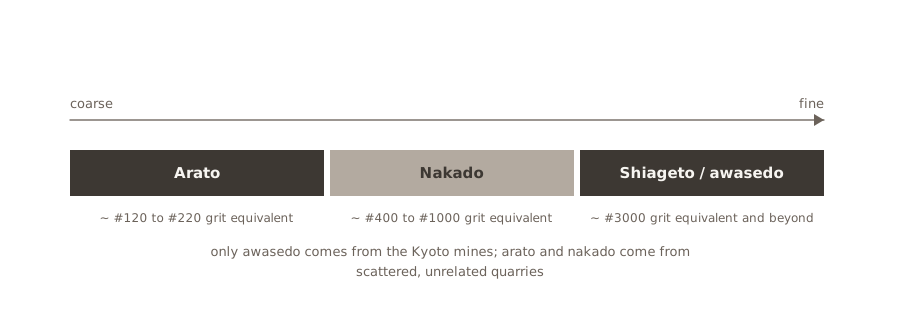
Japanese naturals are divided by role in the progression. This is the most important organizing idea, and it explains a common point of confusion: the famous mine lists online cover only the finishing category.
| Category | Japanese | Role | Approx. synthetic equivalent | Example stones |
|---|---|---|---|---|
| Coarse | Arato (荒砥) | Repair, thinning, setting bevels | ~120-600 | Omura, Natsuya |
| Medium | Nakado (中砥) | Refining the scratch pattern, pre-polish | ~800-4000 | Aizu, Amakusa, Binsui, Tamba Aoto, Ikarashi |
| Finishing | Shiageto / Awasedo (仕上げ砥 / 合砥) | Final edge, polish, kasumi | ~5000-30000+ (loose analogy) | Nakayama, Ozuku, Ohira, Okudo |
Only the awasedo come from the Kyoto mines. Coarse and medium naturals come from scattered quarries across Japan with unrelated geology. Aizu is a nakado, mined in Fukushima Prefecture, which is why it never appears on the Kyoto awasedo charts despite being the most prized natural medium stone.
Where They Come From
The Kyoto finishing stones come from a narrow seam of very fine sedimentary rock, compressed volcanic ash and radiolarian silica laid down on an ancient seabed and later uplifted into the mountains northwest of Kyoto, in the Umegahata and Atagoyama area and extending west toward Kameoka in the Tamba region. Age figures quoted by sellers vary widely, commonly 150 to 250 million years, occasionally much higher (contested, and not worth taking as precise).
Every famous awasedo mine is a different access point into the same tilted stack of layers. That single fact explains most of the naming convention: mines share layer names (tomae, suita, aisa) because they are cutting the same strata at different points along the seam. Local conditions at each mine determine hardness, fineness, and character, so a Nakayama tomae and an Aiiwatani tomae are the same geological layer with different personalities.
The Kyoto Mines
Mines are conventionally grouped as eastern (higashimono, nearest Kyoto city, generally the hardest and finest, most prestigious) and western or central (nishimono, wider range, more suita, often softer). The grouping is a trade convention rather than a strict boundary, and sources do not agree on every mine's assignment. Hardness is given on seller scales of roughly 1 to 5 with plus marks, where Lv 5+ is glassy hard.
Eastern group
| Mine | Hardness (typ.) | Known for | Best use |
|---|---|---|---|
| Nakayama (中山) | 4 to 5+ | The benchmark mine. Fine kiita and asagi tomae and aisa. The Maruka (丸カ) stamp | Razors, kanna, final knife edges, top-tier polishing |
| Shinden (新田) | 4 to 5 | Adjacent to Nakayama, similar character, less famous name | Same work as Nakayama, commonly reported as better value |
| Ozuku (大突) | 4.5 to 5+ | Often the hardest and finest of all. Asagi common. Glassy and unforgiving | Razor finishing above all, advanced users |
| Okudo (奥殿) | 3.5 to 5 | Legendary suita, plus fine tomae | Suita: fast fine polishing, kasumi. Tomae: razors and edges |
| Narutaki (鳴滝) | 3.5 to 5 | Historic mine, fine tomae. The name was once nearly synonymous with awasedo | Razors, fine finishing |
| Hakka (八箇) | 4 to 5 | Dense hard suita, sometimes compared to Okudo suita (reported, thin coverage) | Hard suita work, fine polishing |
Western and central group
| Mine | Hardness (typ.) | Known for | Best use |
|---|---|---|---|
| Ohira (大平) | 2 to 4 (wide) | Huge range: uchigumori for sword polishing, soft shiro suita, tomae. One of the last two with any extraction, associated with the Imanishi family | Sword polishing, kasumi on knives, general polishing |
| Shoubudani (菖蒲谷) | 3 to 4.5 | Celebrated suita, frequently with renge | Kasumi and contrast polishing, mid to fine edge work |
| Maruoyama (丸尾山) | 2.5 to 4.5 | Kameoka mine with large recent output. Suita with renge and nashiji, strata sold clearly labeled | The best learning mine: labeled strata, wide selection |
| Aiiwatani (相岩谷) | 3 to 4 | Solid tomae and aisa | Knife finishing, dependable daily finishers |
| Mizukihara (水木原) | 3.5 to 4.5 | Firmer tomae, some kiita | Knife and tool edges |
| Yaginoshima (八木ノ嶋) | 3 to 4 | Tomae and namito, consistent mid-hard finishers | Knife finishing |
| Hideriyama (日照山) | 2 to 3 | Softer, often purplish. Muddy, fast, forgiving | Pre-finisher, kasumi on stainless-clad, a good first Jnat |
| Atagoyama (愛宕山) | 2 to 3.5 | Soft to medium suita, generous mud | Kasumi finishing, wide bevel work |
| Takashima (高島) | 2 to 3 | Softer stones, hazy even finish | Kasumi pre-finish, cladding contrast |
Notes:
- Any mine can produce stones well outside its typical range. Judge the stone, not the label.
- Nearly all mines closed decades ago. Only Ohira and Maruoyama are reported to see occasional extraction, and even those are effectively supplied from stored raw material held by wholesalers.
- Because the mines are closed, the old mine names are no longer protected in any meaningful way, and new stamps carrying famous names exist. A name on a stone is a claim, not proof.
The Strata
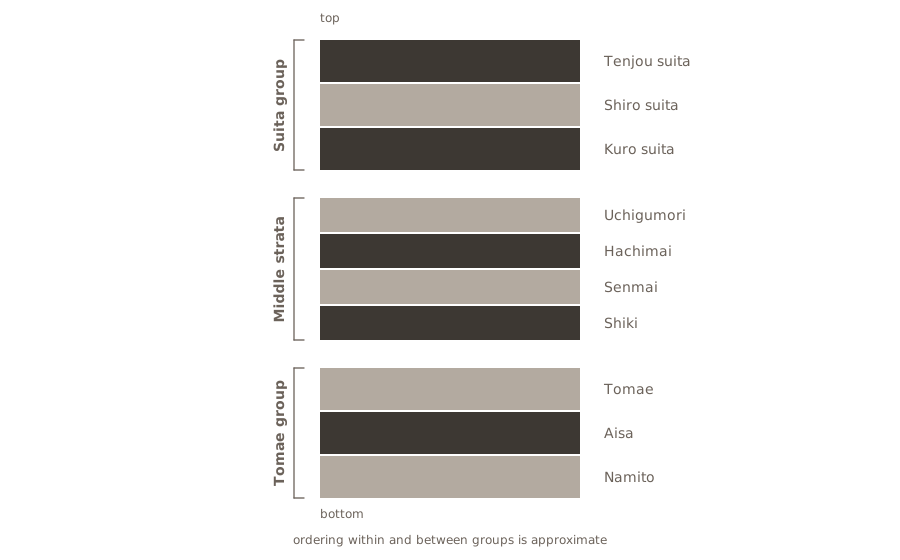
Stones are identified by layer as much as by mine. The two big families are the suita group (upper) and the tomae group (lower). Ordering charts vary by source and by mine, so treat sequence as approximate.
Suita group (upper)
| Layer | Notes |
|---|---|
| Suita (巣板) | "Nest board," named for the small voids (su). Fast for their fineness, generate their own slurry, prized for kasumi. Sunashi (no holes) usually commands more |
| Tenjou suita (天上巣板) | "Ceiling" suita, the uppermost suita layers |
| Shiro suita (白巣板) | White suita, often softer, a classic polishing stone (Ohira shiro suita is the famous example) |
| Kuro suita (黒巣板) | Black or dark suita, often harder |
Middle strata
| Layer | Notes |
|---|---|
| Uchigumori (内曇) | The sword polisher's stone. Hazuya and jizuya finger stones are cut from it. Ohira is the famous source |
| Hachimai (八枚) | "Eight sheets," thin-bedded |
| Senmai (千枚) | "Thousand sheets," very thin-bedded, often flaky |
| Shiki (敷) | Lower "floor" layers, appears in compound names |
Tomae group (lower)
| Layer | Notes |
|---|---|
| Tomae (戸前) | The classic finishing layer. Most fine razor and edge stones, including most kiita and asagi, are tomae |
| Aisa (合さ) | Adjacent to tomae, similar use, often excellent |
| Namito (並砥) | "Standard stone," workhorse layer, usually a step below tomae in fineness |
Colors and Patterns
These are descriptors of appearance, not layers. Some correlate loosely with performance, most are collector interest.
| Term | Meaning |
|---|---|
| Kiita (黄板) | Yellow. Historically the most prized color, associated with fine hard pure stone. Swarf is easy to read against it, which may explain some of the preference |
| Asagi (浅葱) | Blue-grey or green-grey. The classic razor color, common in hard tomae |
| Karasu (烏) | "Crow," black cloudy mottling. Collectible and often excellent |
| Renge (蓮華) | "Lotus," pink or red speckling, common in Shoubudani and Maruoyama suita. Collectible |
| Iromono (色物) | "Colored things," mixed or multicolored stones |
| Nashiji (梨地) | "Pear skin" texture |
| Goma (胡麻) | "Sesame" specks. Fine goma is harmless, hard black goma can scratch |
| Su (巣) | The voids in suita. Soft su is harmless, hard-rimmed su can scratch |
| Kan (筋) | Lines or veins. Inactive lines are cosmetic, hard active lines scratch and hurt value |
| Namazu (鯰) | "Catfish," smooth cloudy patches |
| Sunashi (巣なし) | Suita without su |
Non-Kyoto Stones
Medium (nakado)
| Stone | Region | Approx. range | Character |
|---|---|---|---|
| Aizu (会津) | Fukushima | ~1000-3000 (fine examples higher) | The premium natural medium. Self-slurrying, smooth for its speed, bridges cleanly into awasedo. Mining long ceased, old stock only. Fine examples nearly pre-finish on their own |
| Amakusa (天草) | Kumamoto | ~600-1000 | White and red varieties. Cheap, widely available, the classic workhorse medium |
| Binsui (備水) | Kumamoto | ~700-1000 | Sandstone-type medium, historically paired with Amakusa |
| Tamba Aoto (丹波青砥) | Kyoto Pref. (Kameoka) | ~2000-4000 | The blue-green "aoto." Muddy and pleasant, the traditional last step before awasedo. Mining essentially over, good ones are sought after |
| Ikarashi (五十嵐) | Niigata | ~1000-2000 | Solid mid stone, less common outside Japan |
| Tsushima kuro nagura (対馬黒名倉) | Nagasaki | ~1500-2500 | Black mudstone. Used as a fine medium on its own or rubbed as a nagura on hard finishers |
Coarse (arato)
| Stone | Region | Approx. range | Character |
|---|---|---|---|
| Omura (大村) | Kyushu | ~200-400 | Soft fast-wearing sandstone, the traditional repair stone |
| Natsuya (夏屋) | Iwate | ~300-800 | Harder coarse stone, historically important |
| Iyoto (伊予砥) | Ehime | coarse to medium | One of the oldest documented Japanese whetstone types, now mostly of historical interest |
Modern diamond plates and coarse synthetics outperform all of these for repair work. Coarse naturals are bought for tradition and feel.
Nagura
Mikawa shiro nagura (三河白名倉). Quarried in the Kitashitara district of Aichi Prefecture. The mine has around twelve layers, of which roughly eight are usable and four are commonly sold: Botan (coarsest), Tenjou, Mejiro, Koma (finest). They are rubbed on a hard base stone to build progressively finer slurries, which is standard practice in Japanese razor honing: work through Botan, Tenjou, and Mejiro, rinsing between each, then Koma or a tomonagura, then clear water on the base stone. The quality-control stamping system was established by Nagayuki Asano (with Kousuke Iwasaki), and the stamps have since passed to Morio Sakamoto, who continues to grade stones. Uncertified nagura are cheap for a reason: hard inclusions can scratch both the blade and the base stone. Koma is genuinely scarce and is the piece most often misrepresented.
Tomonagura (共名倉). A small piece of awasedo, ideally the same stone or slightly softer, used to raise slurry on the base stone without introducing a different abrasive. The safest option for knife work, since it cannot contaminate the scratch pattern.
Grading and Buying
- Hardness is a seller scale, commonly Lv 1 to 5 with plus marks. Softer means more mud, faster cutting, more forgiving, hazier kasumi. Harder means finer feedback, a brighter finish, and less tolerance for sloppy technique. Scales are not standardized between sellers.
- Fineness is independent of hardness. Some sellers rate it separately.
- Size stamps. Traditional full-size bench stones carry wholesaler size classes (30, 40, 60, 80). Koppa (こっぱ) are irregular offcuts and are the sensible entry point: the same rock, a fraction of the outlay, at the cost of size and shape.
- Stamps to know: Maruka (Nakayama stock associated with the Kato family), Maruichi, Asano (Mikawa nagura), Imanishi (Ohira). Stamps carry large premiums and are faked. Whether a famous stamp performs better than an unstamped stone of the same layer is disputed, and some experienced sellers argue openly that it does not.
- Flaws to check: active kan, hard-rimmed su, toxic inclusions (hard black spots that scratch), and cracks. The traditional crack test is tapping the stone and listening for a clear ring rather than a dull thud.
- Attribution on the secondhand market is frequently optimistic or wrong unless the stone carries original stamps or comes from a trusted dealer. Buy the stone as described in front of you, not the name.
Matching Stone to Use
| Goal | What you want |
|---|---|
| Straight razor finishing | Hardest, finest tomae or aisa: Ozuku, Nakayama, Shinden, hard Okudo. Asagi is common. Plus a Mikawa nagura progression or a tomonagura |
| Kitchen knife edges (final) | Lv 3 to 4.5 tomae or aisa from almost any mine. Kiita and asagi tomae are the classics |
| Kasumi and wide bevel polish | Suita (Okudo, Shoubudani, Ohira, Maruoyama) and softer stones (Hideriyama, Atagoyama, Takashima) for haze. Harder stones brighten the core steel |
| Kanna and chisels | Hard, fine, flat stones: Nakayama, Ozuku, hard suita |
| Sword polishing | Uchigumori from Ohira, plus hazuya and jizuya finger stones |
| Pre-finish step | Aizu, Tamba Aoto, Tsushima, or a soft muddy awasedo such as Hideriyama |
| First natural stone | A soft suita, a Hideriyama-type stone, or a labeled Maruoyama koppa. Forgiving, obvious feedback, cheap enough to learn on |
Care
- Seal the sides and base with lacquer (traditionally kashew, a cashew-based lacquer) or urethane to keep water out of the stone. Many stones are sold mounted on a wooden base (dai), which serves the same purpose.
- Flatten with a diamond plate. The Atoma 140 and 400 are the community standard.
- Water only, never oil. Do not soak finishers, splash and go. Soaking a fine natural risks softening and cracking.
- Store dry and above freezing. Water trapped in a stone that freezes will crack it.
Glossary
| Term | Meaning |
|---|---|
| Toishi (砥石) | Whetstone |
| Tennen toishi (天然砥石) | Natural whetstone |
| Awasedo (合砥) | Finishing stone, specifically the Kyoto strata |
| Shiageto (仕上げ砥) | Finishing stone, general term |
| Nakado (中砥) | Medium stone |
| Arato (荒砥) | Coarse stone |
| Togijiru | Slurry raised while sharpening |
| Nagura (名倉) | Slurry stone |
| Tomonagura (共名倉) | Slurry stone of the same or similar rock as the base stone |
| Kasumi (霞) | "Mist," the hazy cladding finish |
| Hagane / Jigane | Hard core steel / soft cladding iron |
| Kamisori (剃刀) | Straight razor |
| Dai (台) | Wooden base |
| Koppa (こっぱ) | Offcut, irregular stone |
Sources: user reference document on Japanese natural stones; Japanese Natural Stones (JNS) mine and nagura pages; TomoNagura.com Asano nagura and stamp pages; NaturalWhetstones.com mine list and glossary; Fikira / historyrazors mine and kanji pages; Imanishi retail listings (Chefknivestogo, Element Knife, Gritomatic) for mine attribution and current supply.